
By Paul Post
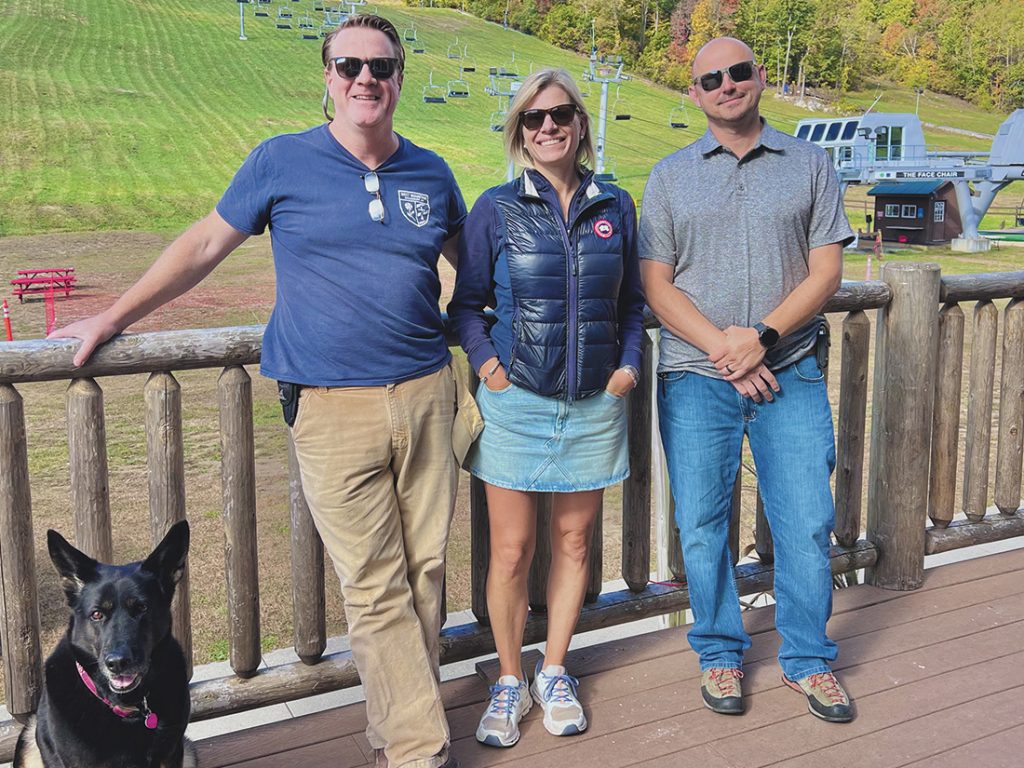
West Mountain is nearing the finish line on approvals for a $190 million ski-and-stay village, which co-owner Spencer Montgomery says is essential to the ski center’s survival.
“It isn’t kind of based on this resort happening, it’s absolutely based on it happening,” he said. “Last winter was a difficult one. We lost money. In this game, you have a year like that, you spend two years trying to make up for it.”
“A resort puts us in a very safe economic position,” he said. “It really will be the only true ski-and-stay resort village in New York state except arguably Holiday Valley, about six hours west of here. It will allow us to siphon off a lot of traffic that gets off Exit 20 and heads to Vermont.”
Montgomery, his wife, Sara, and unnamed financial partners have spent $15 million on upgrades such as new chair lifts, extensive snowmaking improvements and overhauling the base lodge since purchasing the Queensbury center about 10 years ago. They’ve also incurred $5 million in operational losses.
The resort, called Woods at West Mountain, would be located near the Northwest base lodge. Plans call for a 60- to 80-room hotel and conference center, 64 condominiums, 32 two-unit duplexes and 52 custom single-family homes surrounding a new high-speed chairlift in a village-type setting with a full-service ski store, athletic club, coffee shop, grocery market and restaurant.
“You wouldn’t have to leave the property,” Montgomery said. “Everything you need would be right there. It will be open to the public, too. In fact, I’ve gotten a lot of inquiries from local empty-nesters who are thinking of downsizing.”
West Mountain opened in the early 1960s with a focus on providing family-friendly skiing for the Greater Capital Region. Night skiing has been one of its major draws in addition to a highly successful racing program for children, teens and young adults.
With a resort, Montgomery’s goal is to make Queensbury a bona fide destination ski town.
“We already put a ton of heads in (hotel) beds,” he said. “We have 51 days of racing here. Every weekend we have two- to four-day events. They’ve built three new hotels at Exit 18 since we took over and it’s still hard to get a hotel room.”
He hopes to obtain final approvals from the Queensbury planning and town boards early next year, start site work next fall and get construction under way in 2026.
But first, plans call for creating a 10-12-million gallon pond to provide water for snowmaking on the north side of the mountain, where the resort would be located.
“Increased snowmaking has to happen,” Montgomery said. “Nobody is putting in a 512-door, $190 million ski-and-stay resort if there’s no skiing by Christmas week.”
Last winter’s climate change-related mild weather wreaked havoc, sometimes melting snow as fast as it could be made.
“January was one of the warmest on record,” he said. “It just was a real dogfight. Toward the end of the year it got better, but people had put their skis away by then. With extra water I could have put on a real good show for our patrons.”
West Mountain gets its water from the Town of Queensbury treatment plant on the Hudson River, with a limit of 3,000 gallons per minute. At present, snowmaking crews start on the south side of the ski area, at the main base, working their way north a few trails at a time eventually covering the north side serviced by the Apex chairlift.
Plans call for lining a sand pit, created by excavation work many years ago, enabling it to store water. Town water could be stockpiled in the pond when temperatures were too warm to make snow, and utilized for extra on-demand snowmaking capacity.
An additional pump house would be added at the Northwest base allowing for simultaneous snowmaking on both sides of the mountain early in the season.
These projects would cost about $1 million. Montgomery said he hopes to obtain grants and possibly some Warren County occupancy tax money to fund them.
“We’ve already put in the snowmaking guns,” Montgomery said. “It has to happen for the resort to be successful. I think the public would like it because the whole mountain would be open early. It would allow us to have 60 percent to 70 percent of primary trails open by Christmas week. People would look at West Mountain differently.”
Also, the potential exists to add a separate 12-inch line drawing water from the town plant, before it’s treated, to increase on-demand snowmaking capacity. This might cost another $2 million.
“The game plan from the beginning was to fix the mountain first, then move to the development piece,” he said. “That’s how I pitched that to my partners. West Mountain is an awesome mountain. It has 1,000 feet of vertical, 1.2 mile trails, 130 ski-able acres. It’s big enough to ski like a big mountain.”
“My family’s been involved here since 1968,” Montgomery said. “I hate to say it, but if there was just West Mountain here and no land (ski village) to develop I don’t think West Mountain would exist.”
Ticket sales, greatly dependent on good weather, currently account for about 70 percent of the center’s annual revenue stream.
“With a resort (offering more amenities) tickets would only be five to 10 percent,” Montgomery said. “It takes the weather risk out. It takes the ski area out as the primary revenue generator.”
West Mountain has a significant impact on the local economy with a roughly $2 million payroll supporting 350 people at peak times and a full-time, year-round staff of about 30.
In preparation for winter 2024-25, Montgomery has hired a new head of outdoor operations, Laszlo Otvos, whose extensive experience includes 20 years at Mammoth and Soda Springs ski resorts in California. He’ll be in charge of lifts, snowmaking, grooming, staffing and scheduling.
West Mountain has also hired a new head chairlift mechanic.
With an eye toward competitive pricing, the center is offering a new 518 Card ($51.80) that gives customers 10 percent off lift tickets, food and beverage, rentals and merchandise. Card holders are also entitled to $30 twilight tickets from 5 p.m.-9 p.m. on Monday and Tuesday.
“I think it will be really popular with locals,” Montgomery said. “Things are a little tougher economically than they were a few years ago. We’re giving them a little break.”