
Courtesy NY Apple Association
By Paul Post
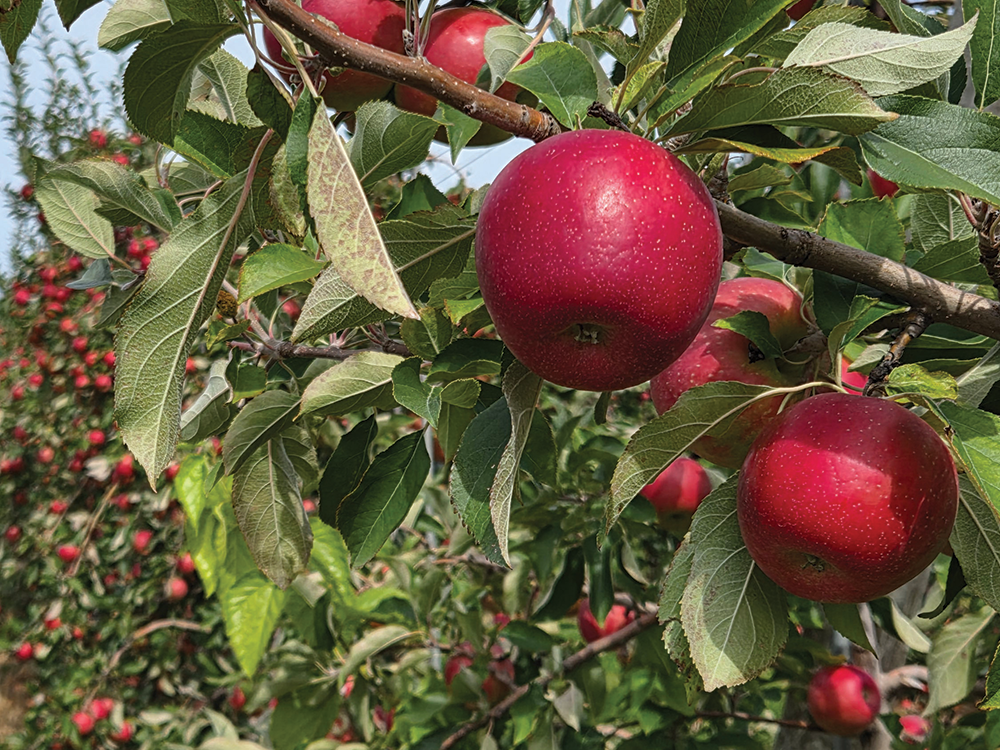
Industry leaders call it a two apple season.
“The color and flavor this year are phenomenal, where if you have one apple it’s so good you immediately reach for another one,” said Cynthia Haskins, New York Apple Association president. “If you haven’t tried a new crop apple yet, go out and buy some. They really are good.”
New York is the nation’s second-leading apple producer, surpassed only by Washington state; a $2.1 billion industry that supports nearly 12,000 jobs, a Cornell study says.
The impact is especially important to rural small towns and hamlets where farms are located, as there are 150 you-pick destinations that draw huge crowds on autumn weekends. Visitors quite often patronize other small business, too, such as retail shops and convenience stores during fun family outings.
A recent Warrensburg Apple Festival gave a variety of local vendors a chance to market their products in this Adirondack town.
In Argyle, Washington County, McWhorter’s Orchard owner Mel McWhorter said, “We’re very, very busy. We’ve got a lot of activity. Traffic through the building here is very good. Ninety percent of our business is from Warren and Washington counties, but I always look at the address when people pay with checks. We get customers from Crown Point to the Schoharie Valley and some from Poultney, Vt.”
Bowman Orchards in Rexford, southern Saratoga County, is a full-fledged agritourism destination featuring a “Stalked: Haunted Corn Maze” and extensive children’s play area with rides.
Its popular Farm Store has a wide variety of goods from donuts, kettle corn and candy to fresh produce, baking mixes and country-themed ornaments.
“It’s open till Christmas, then we take a short break and are back up in mid- to late-January,” owner Kevin Bowman said. “There’s a big push on the hard cider side this year. People seem to really be enjoying that.”
This fall’s statewide harvest is expected to total about 30.5 million bushels, similar to last year. The apple industry has a direct economic impact through farming and indirectly through processing, packaging, storage and the growing craft cider sector.
In July, the state awarded the Apple Association $1.5 million for two promotional initiatives. The first focuses on consumer marketing through social media, digital advertising and media outlets. A second program supports in-store promotions, merchandising, cooperative advertising and retailer engagement to drive increased sales and visibility of New York apples.
One of the entire agriculture industry’s major concerns, not just apple producers, is the impact of Trump administration immigration enforcement. All kinds of farms rely heavily on foreign workers to handle tough, physically-demanding jobs that many Americans refuse to do.
Increased enforcement may cause labor shortages, resulting in higher labor costs, crop losses and increased food prices for consumers. Supply chains are also disrupted and farm profitability is threatened.
While there’s a long-term push for automation, it cannot fully replace the current labor force.
Bowman said he might eventually use robotic apple picking machines to harvest some of his orchard. “We’re headed in that direction,” he said. “We’re not ready yet.”
For robotics to work, farms have to replace older tall trees with shorter, high-yielding trellis-type trees.
But Clifton Park, where Bowman’s is located, is so heavily developed that there’s very little available land to expand and plant more trees.
“So we need to grow a little bit taller trees,” Bowman said. “This year our workers are picking the tops of trees with platforms. Our you-pick customers don’t need ladders. It’s easier for them. They just pick the lower branches.”
Bowman’s has six workers under the H-2A program, a temporary visa program that allows farms to fill seasonal jobs with foreign help if there aren’t enough domestic workers available.
“We have zero concerns with ICE (U.S. Immigration and Customs Enforcement) because we do it the legal way,” Bowman said. “I don’t understand why other people don’t. If everybody did it the legal way there wouldn’t be any concerns. It costs a lot of money. That’s why some people don’t do that. But some things are more important than just the money.”
“We have a friend who’s an ICE agent,” he said. “We ask him how they know which farms to go to. He said, if they don’t have legal workers, that’s where they go. It’s all on the computer.”
Haskins, the Apple Association president, said she hasn’t heard of any cases in New York where immigrant apple pickers have been late arriving for this year’s harvest.
“That doesn’t mean that it hasn’t happened,” she said. “I just haven’t been notified.”
But some immigrant workers, both undocumented and legally authorized, are now hesitant to work and stay home following news of raids, which has shrunk the pool of available and reliable labor.
In June, ICE raids on farms in California and Pennsylvania led to significant crop losses as workers stopped showing up for work.
Bowman said other types of government intervention are more of a concern to his operation. “The biggest thing is increased regulations from every angle,” he said. “That is probably more of challenge than the weather.
Several years ago, the state enacted new overtime pay requirements for farmworkers. But if farms can’t afford to pay such higher wages, laborers don’t work as long and earn as much as they used to.
Much of this year’s crop has already been harvested, but later apple varieties such as Melrose, Jonagold, Northern Spy, Red Delicious, Ida Red and Spy Gold are still available. “Everybody seems to have their preference and navigate to their favorite apple, for either eating or cooking,” MacWhorter said. “We stay open till the crop is gone and we don’t have any problem getting rid of them.”