
Courtesy Lake George Chamber
By Anne Donnelly
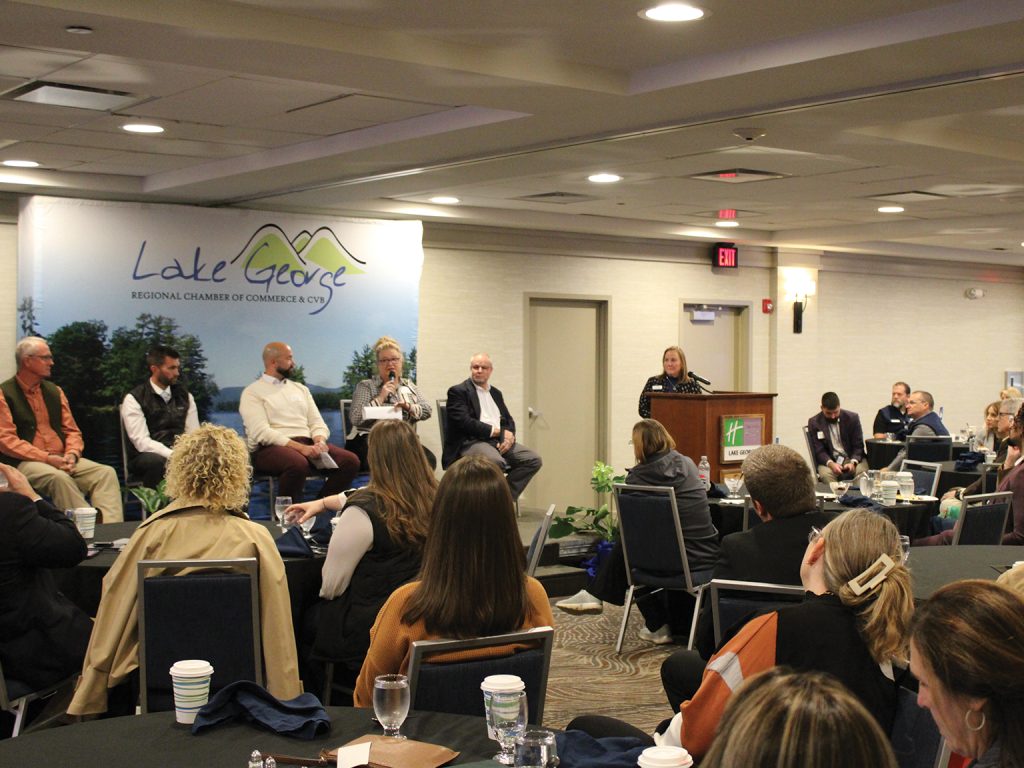
The Lake George Regional Chamber of Commerce’s Fall Economic Outlook Breakfast was held Oct. 16 at the Holiday Inn Resort Lake George, bringing together local business leaders to review economic trends and outlooks for the coming year.
Katie Cook and Dylan Forsyth of Zartico Inc., a visitor-intelligence company that partners with the Chamber to analyze spending, lodging, and geolocation data across Warren County, presented several key findings. Visitor spending rose to 35 percent at local businesses in the third quarter of 2025, up from 32 percent a year earlier. Despite a slight dip in average daily spend, restaurants, retail, and arts sectors saw gains.
Lake George continued to attract more visitor spending than most of the Capital Region, underscoring the area’s diverse, resilient economy. Hotel occupancy slipped slightly from 84 to 82 percent, but the average stay increased to 2.2 days, boosting overall revenue. Cook noted that travelers are now booking further in advance—a positive sign for the tourism sector.
The Industry Conversation Panel, moderated by Gina Mintzer, LGRCC executive director, featured:
– John Carr, owner and founder, Adirondack Pub & Brewery
– Tyler Herrick, president and general manager, Spruce Hospitality Group and The Queensbury Hotel
– John Howard, senior district manager, Stewart’s Shops
– Christine Powers, chief marketing officer, Revolution Rail Co.
– Gary Thornquist, general manager, Lake George RV Park
Panelists described 2025 as a year defined by economic stress and shifting consumer behavior. Herrick said he “looked at this year as a year of uncertainty.” Carr cited nearly constant rain from November through June, which dampened impulse visits and slowed early-season spending. “People were buying a lot more hamburgers than steaks,” he said, but added that fall finished strong: “I think we’re all sick of hearing the news. So, hey, let’s go out and buy a steak.”
Thornquist noted that holiday weekends, which usually attract blue-collar families, were down—suggesting that demographic felt greater economic strain. In contrast, higher-income travelers helped sustain strong summer months, aided by better weather.
Across the board, panelists emphasized enhancing the guest experience and building authentic relationships. Carr said, “The experience that a guest has at your place with you or your staff is probably the most valuable commodity that you sell.”
Howard advised small businesses to “focus on what makes you different and go all in on that,” adding that Stewart’s continues to expand grocery offerings in communities that have lost supermarkets while maintaining its hallmark ice-cream brand consistency.
Powers highlighted what she called “radical collaboration” in today’s “collaboration economy.” She said successful partnerships don’t require discounting: “We offer a premium ‘done-for-you’ package. We actually mark it up, but people love it because it’s done for them.” She also stressed the growing role of data analytics, noting her company’s investment in an upgraded customer-relationship-management system to personalize outreach.
Thornquist discussed how Lake George RV Park continues to invest in amenities such as pickleball courts and a dog park, as 60 percent of campers travel with pets. “The customer is all about the experience,” he said.
Addressing staffing, Herrick reframed the issue as one of productivity rather than shortage. “I don’t think we have a labor shortage. I think we have an issue with productivity,” he said. Howard emphasized retention through empowerment, while Carr said he keeps long-term employees by offering responsibility and advancement opportunities.
Panelists ended on a cautiously optimistic note for 2026, despite rising operational costs. Herrick expressed excitement about the revitalization of downtown Glens Falls and The Queensbury Hotel’s 100th anniversary next May. Thornquist voiced hope for the return of Canadian visitors, who were “pretty much non-existent this year.”
Overall, both data and discussion reflected a resilient Warren County economy. Success in 2026, panelists agreed, will depend on delivering exceptional guest experiences, strengthening collaborations, and leveraging data-driven insights to guide strategy.