
Paul Post
By Paul Post
Slow, steady tourism growth is one of the best options for achieving sustained economic development in Washington County, officials say.
Events such as the Greenwich Lighted Tractor Parade on Saturday, Nov. 22, Scottish Games in Argyle and Whitehall’s new Sasquatch Festival attract people from outside the area who support small business that keep small towns and villages vibrant.
“Are we going to see the likes of a Micron or Regeneron in Washington County? Probably not,” said Laura Oswald, county economic development coordinator. “Economic development has pretty much happened under tourism initiatives. What we have out there is phenomenal. To my mind you grow what you have. We have open space, we have natural resources. For somebody living in a city, to have an experience going to a rural area is marketable.”
“Heck yeah, people want to come here,” she said.
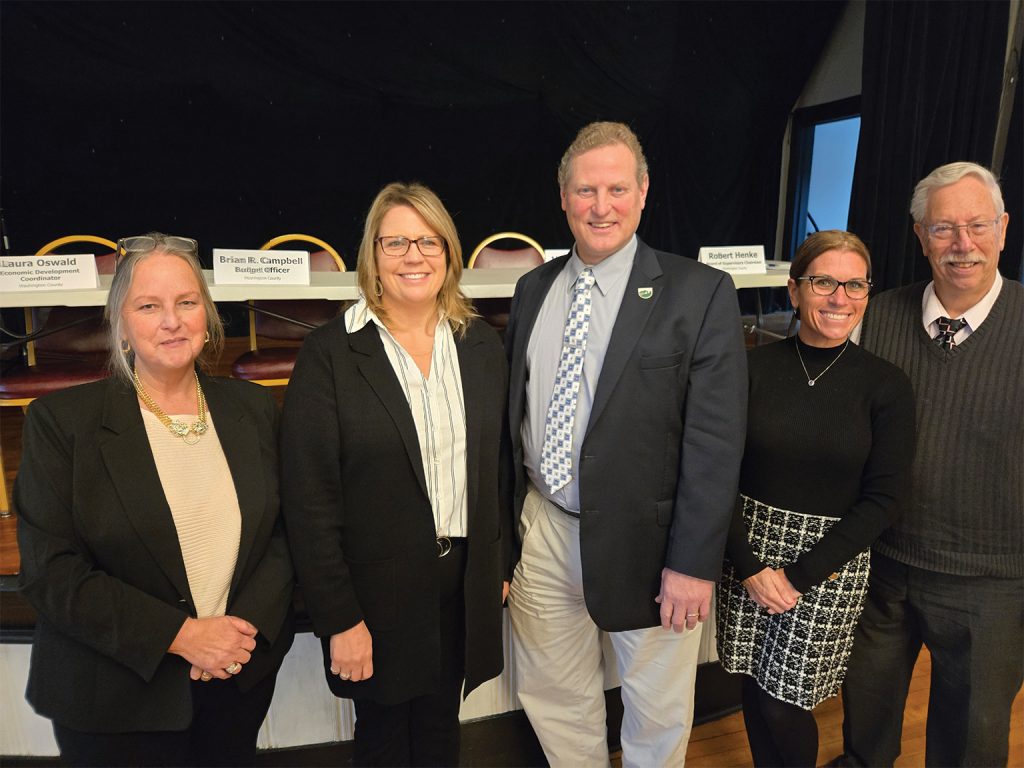
Oswald, Budget Officer Brian R. Campbell, county Administrator Melissa Fitch and Board of Supervisors Chairman Robert Henke discussed this and other issues during a Nov. 10 “State of Washington County” program hosted by Adirondack Regional Chamber of Commer at the Sandy Hill Arts Center in Hudson Falls.
Dozens of area business and civic leaders attended the event.
A decade or more ago, many supervisors didn’t grasp tourism’s potential and the county still doesn’t have a dedicated budget for tourism or economic development.
“But the mindset’s changed,” county Administrator Melissa Fitch said. “We need people to visit the county and we need to give them resources so the county can continue to grow.”
At present, the county gets about $120,000 annually in the form of Airbnb short-term rental tax revenue, all of which is used to promote tourism along with about $50,000 from the state’s I Love NY program.
Until now, Vrbo hasn’t paid such fees, but new legislation signed by Gov. Kathy Hochul requires all short-term rental platforms marketing overnight stays on the internet to pay such tax.
“We are conservatively estimating that with Vrbo especially, the total will increase revenue $60,000 to $70,000,” Oswald said.
This pales in comparison to the large sums Warren and Saratoga counties spend to promote tourism, but should provide a significant benefit nonetheless, she said.
Washington County Fair is the state’s third largest county fair, attended by more than 100,000 people annually, and seasonal attractions such as Maple Weekends and apple picking at places such as Hick’s Orchard in Granville draw visitors from far and wide.
Fitch praised Oswald’s office for making the most of every tourism dollar it gets.
A new 2026 calendar produced in cooperation with local historians touts many of the famous people, places and landmarks in Washington County that contributed to the nation’s growth, as America prepares to celebrate its 250th birthday next year.
Entitled “History Happened Here,” it encourages people to visit local museums such as the Pember in Granville and learn about figures such as Hebron native Samuel Nelson who served on the United States Supreme Court.
A separate full-color flyer with a map of the county lists and invites people to visit the county’s many parks and hiking trails, explore its villages and enjoy numerous stops on craft beverage, cheese, antique and fiber trails. Arts studios and stage productions are also promoted.
“We have extremely resourceful employees at the county,” Fitch said. “They’re used to doing much with little. They have to.”
“We shouldn’t undersell tourism,” Henke said. “That may be our best industry.”
And it’s especially vital now as the county struggles with difficult fiscal challenges primarily caused by unfunded state mandates, he said.
Medicaid alone costs the county $222,000 per week. Skyrocketing health insurance costs and a raise in the retirement program rate are also burdensome.
In addition, Henke said homelessness across the state is up 200 percent.
“The law says we’ve got to take care of them when they walk in the door,” he said. “Being housed is a civil right, but we’re (the state) only going to pay you 25 percent of what it costs.”
The county has no Code Blue shelters, which some supervisor disapproved several years ago, so people are put up in motels costing more than $100 per night, plus transportation. “That’s our only alternative in Washington County,” Henke said. “These things hit us all at once.”
The county is expected to adopt a $143 million budget for 2026 with a nearly 17 percent tax levy increase.
No layoffs are anticipated, but Campbell said about 60 positions that are vacant or soon to be vacant because of retirement won’t be filled. “It’s going to take a lot of restructuring,” he said.
“You have to want business, you have to want change or taxes will go up,” Fitch said. “We’ve got to make Washington County a place we can all afford to live.”
Henke said the best quick-fix for economic development would be a big-box store such as Walmart, which had considered putting stores in Whitehall and on Dix Avenue in Kingsbury at the site of the old Dix Drive-In Theater. But in both cases, local small business owners fought the idea because of potential impacts on their stores, he said.
Instead, Walmart built a Supercenter about two miles away from Kingsbury, off Quaker Road in Queensbury. The store employs more than 100 people and generates tens of thousands of dollars in sales tax revenue.
“It makes me sick every time I drive by it,” Henke said.
Oswald said improved infrastructure is a critical need for promoting economic development. “Most people live in villages, but most of our small villages do not have wastewater,” she said. “That has very badly affected the ability to grow in places like Salem and Argyle.”
A developer wants to put new housing in Salem, but can’t because of prohibitive infrastructure costs, she said.
On a more positive note, however, Oswald said Hudson Headwaters recently opened a new facility in Salem that not only serves the local public, but some residents of neighboring Vermont as well. “We want to bring money in from out of state,” she said. “The more of that we can do the more impact it has.”
Officials also discussed the fate of Great Meadow Correctional Facility in Comstock, which closed a year ago this month. Hundreds of corrections officers had to transfer, find new employment or lost jobs altogether.
Prospects for repurposing the property are slim to none.
“It’s going to take a constitutional amendment to use it for anything other than a prison, which would be very hard to get through,” Henke said.
A portion of Washington County lies within the Adirondack Park. By law, “that means the state cannot sell or reuse any parcel of more than 100 acres other than for its original purpose without legislation,” Oswald said. “Even if Empire State Development wants to redevelop it, they can’t without state legislation. Unfortunately, it’s out of our hands.”