
Courtesy EDC
By Paul Post
Eurasian milfoil, a harmful aquatic invasive species, might have a new use as compost or an ingredient in fertilizer.
Trucks could be modified with a device that works with brine and rock salt to reduce the amount of salt on highways that impacts lakes and streams.
These are just two examples of potential business opportunities that would support ongoing efforts to protect the North Country’s natural resources.
“We should launch companies here that know how to do those things,” said Jim Siplon, president of the Warren County Economic Development Corporation. “You’ll never site an Amazon distribution center in the Adirondack Park. What we have to do is, beyond tourism, what are things we can invest in that will bring economic value and be aligned with the values of the park. Launching industry around protecting natural resources and having it based here is one of those things.”
The EDC is collaborating with other entities such as RPI, the Darrin Fresh Water Institute and the Lake George Association to develop ideas that could be presented to the state for economic development.
At present, there are 16 different clusters, such as financial services, green energy and chip manufacturing, that the state has identified for investment and to attract companies to launch and conduct business in those fields.
“I want to add natural resources to that portfolio,” Siplon said.
The immediate goal for 2026 is to define specific investable business ideas that would be presented to the state for support.
This could be in the form of grants, tax breaks or direct efforts by the state to attract new firms to the North Country.
“One of the most important things to remember is that economic development isn’t year to year,” Siplon said. “It requires ongoing support and consistency for a long time. For example, the Downtown Revitalization Initiative in Glens Falls took 10 years to come to fruition.”
“But that $10 million, through the challenges of COVID-19 and mayoral changes, has led to another $50 million investment that’s had a dramatic effect; hundreds of new housing units and an entire new commercial corridor. The place has become a better version of itself. That same kind of activity is what’s happening in North Creek.”
A new wastewater treatment facility, scheduled for completion this year, has made $40 million worth of investment possible in North Creek.
This includes a $25 million new ski bowl, a $10 million overhaul of the former Phoenix Hotel, and several smaller projects.
A New Jersey property developer is pursuing plans for a schnaps micro-distillery.
Eventually, a zip coaster thrill ride will be built near the new ski bowl, attracting thousands of summertime visitors to North Creek, complementing the winter ski season.
The treatment plant has been made possible in part with occupancy tax from the county.
“It’s already generated the kind of leverage and return that shows it to be a wise investment,” Siplon said. “Any time we can put a million or $2 million to work and generate $40 million in outside investment, it’s always a good decision. All of these things were dependent on having a wastewater system. It couldn’t have happened without it.”
Elsewhere in Warren County, plans are moving forward for West Mountain’s proposed $200 million ski-and-stay village in Queensbury.
The project, called Woods at West Mountain, would be located near the Northwest Base Lodge.
Plans call for a 60- to 80-room hotel and conference center, 64 condominiums, 32 two-unit duplexes and 52 custom single-family homes surrounding a new high-speed chairlift in a village-type setting with a full-service ski store, athletic club, coffee shop, grocery market and restaurant.
That effort, combined with work going on in North Creek and downtown Glens Falls, represents more than $300 million in economic development, and many other smaller projects are taking shape throughout the county as well.
“It’s a staggering amount of money and it came together because we stayed the course,” Siplon said. “We provide the continuity that helps us get to those difficult places that require years and years of ongoing effort.”
The local economy has three main sectors — tourism and hospitality, health care led by Glens Falls Hospital and Hudson Headwaters, and a third group comprised of various categories from retail and light manufacturing to professional services.
“We focus very much on the emerging areas of growth, people who are able to do what they do anywhere and choose to do it here,” Siplon said. “They’re not necessarily remote workers. They’re people who provide critical services like financial or creative services. And they want to live in a place where they can balance work and other things, and this is a really attractive place.”
The concept of protecting natural resources to provide economic as well as environmental benefit fits perfectly with this strategy.
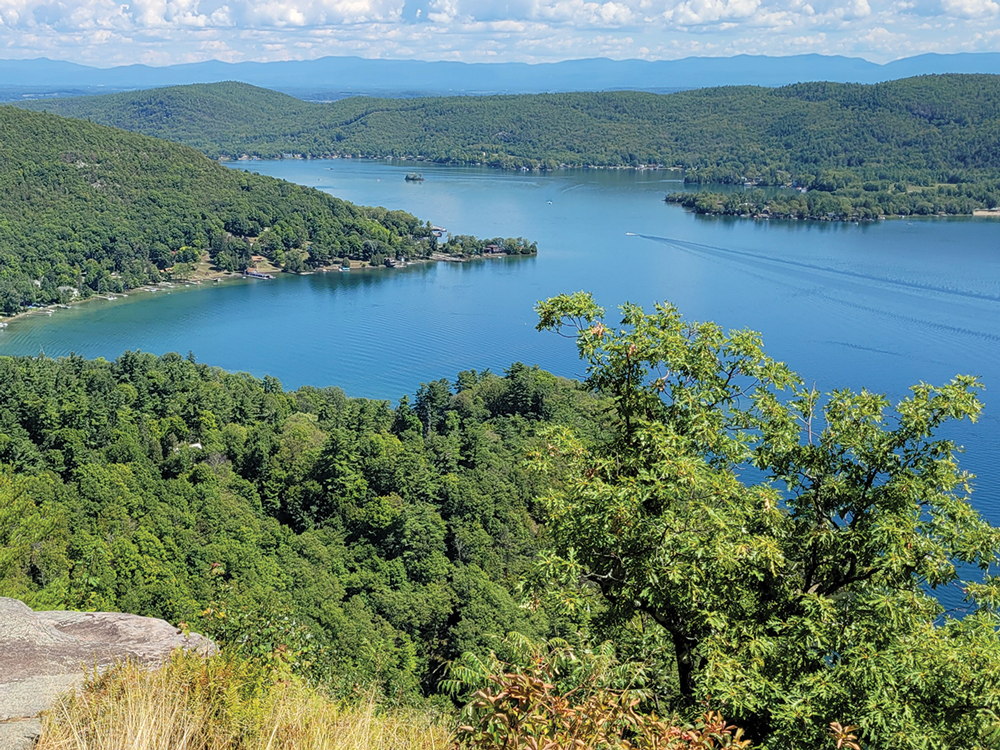
“Lake George is probably the single greatest economic asset we have,” Siplon said. “It’s the thing that we’re known for. It’s got worldwide identity. Tourism is the thing it’s best known for, but it affects all sectors.”
“Lake George is viewed as one of the most pristine water bodies in the world,” he said. “It’s a great example of what happens when a community commits itself to protecting a resource like that. But the knowledge base that’s gone into it has never been converted into more enterprise and more business.”
Efforts to control harmful algal blooms, invasive species, stormwater and the impact of septic systems; these are things that not only affect Lake George, but every community that has freshwater resources, Siplon said.
“We should be trying to take the knowledge and experience we have and turn that into successful business that can help not only here, but other places,” he said. “Ninety two percent of Warren County is in the Adirondack Park and a large portion of Washington County, too. North of us, Essex and Hamilton counties are entirely within the park. This is not just about us. It’s about the entire northern New York economy.”