
Courtesy Paul Post
By Paul Post
From a new planning and zoning department to downtown parking initiatives, Glens Falls is pursuing steps large and small to attract business and promote economic development.
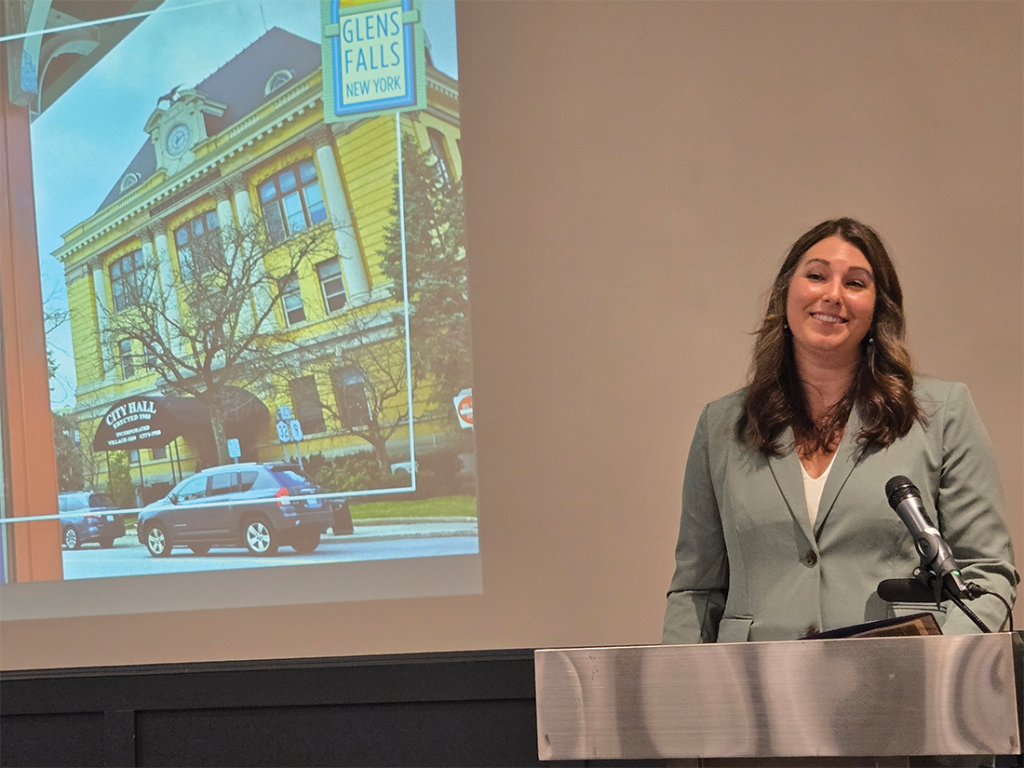
Mayor Diana Palmer outlined those steps during a recent wide-ranging speech covering her first 100 days in office at Heritage Hall in Harding Mazzotti Arena.
“Being mayor of a small city is about solving problems,” she said. “At any given time, there will be new problems that need careful thought and solutions. The beginning of my administration was no exception. In January, we confronted a number of ongoing problems, and I am proud of the progress my administration has made on all of them.”
One of the most significant items she discussed was a proposed transfer of operations and sale of the city’s Fire Road ice rink, near the YMCA, to the Adirondack Youth Hockey Association. The facility was temporarily closed last year because glycol leaked from its cooling system.
The situation was managed, but the city is still seeking a long-term solution.
Palmer said AYHA will assume responsibility for the remediation, removing the risk of such costs — possibly millions of dollars — from the city. The move would also save the city budget about $250,000.
Three high school teams call the rink home, and it hosts numerous youth hockey events, often with teams from outside the area, benefiting local hotels, restaurants and many small businesses.
AYHA President Royce Lawrence said, “Our program alone brings in tens of thousands of people to the community every winter.”
AYHA has used the facility for 40 years. AYHA and city attorneys are negotiating an agreement that may or may not involve AYHA ownership, but the organization will do whatever it takes to keep the rink open, including buying it, Lawrence said.
“We’re trying to be the best community member possible and make sure that facility stays open, not just for us, but the entire community,” he said.
Palmer, who previously chaired the city Recreation Commission, said, “We are looking at ways to grow our recreational offerings and expand sports tourism, including youth sports.”
On a related note, she said the city is pursuing new ways, in cooperation with the county Tourism Department, to promote special events downtown. “We will be sharing the county’s application portal for occupancy tax funding for special events,” she said. “This is going to create a more fair and consistent process for the community groups that organize events in our city.”
One of Palmer’s first steps as mayor was creating a new planning and zoning department, separate from building and codes, which she said makes it easier for people to get the information and approvals needed to invest in Glens Falls.
“We want to make the city as user-friendly as possible for people who want to do business here,” she said. “And that starts with setting clear expectations and having clear processes from the beginning.”
One resident asked what steps are being taken to fill vacant storefronts on Glen Street. The new planning and zoning department will help people bring proposals to the Planning Board for review, the mayor said.
In addition to South Street’s transformation, considerable investment is occurring outside downtown. “KRU Coffee’s new cold-brew production facility in Tech Meadows (West Glens Falls) is now under construction and will add jobs and diversity to our local economy,” Palmer said.
In addition, the Warren County Economic Development Corp. has presented the city with a new strategy, based on smart-growth principles, for bringing more business to Tech Meadows.
“Manufacturing is growing too,” Palmer said. “Adirondack Mechanical Services is preparing to move into a long-vacant warehouse at 7 Pruyn’s Island Drive, bringing a minimum of 50 jobs into our community. Even the Glens Falls office sector is expanding, reversing an office downsizing trend that continues around the country.”
For example, four new tenants are expected to move into the high-rise at 333 Glen St. soon, bringing more than 70 office and professional jobs downtown. The building’s occupancy dropped significantly following the pandemic as large tenants shifted to hybrid work models. “New tenant deals are smaller, but more diverse, and that diversification is creating a more stable office market moving forward,” the mayor said.
Parking, vitally important to business, continues to be a major challenge downtown, especially with dozens of new apartment and condo units opening soon. “Historically, Glens Falls has grown quickly without always planning carefully for how that growth affects parking,” Palmer said.
Several steps are designed to improve the situation while eliminating the need for a multimillion-dollar new parking garage. First, the two-hour time limit is being extended to three hours, giving people more time to attend meetings and do business without getting a ticket.
“Second, we have removed time limits outside the downtown core,” Palmer said. “That means if you need to be here all day, you can park a couple blocks away and walk in.”
Third, the city is working with businesses and other parking lot owners to make lots available to the public at night and on weekends, when special events are held. “Fourth, we are taking a hard look at the permit system,” she said. “Right now, we are not charging market rate and as a result, some people are holding more spaces than they actually need. Those spaces often sit unused, but because they are assigned, no one else can use them. We are moving toward a more flexible system that includes daytime permits, night and weekend permits, and full-time permits for those who truly need them.”
“By matching permits to how people actually use parking, and by adjusting the pricing, we can free up spaces that are currently sitting empty and make them available to more people,” the mayor said.
The city is also considering reducing the size of parking spaces from a maximum of 26 feet to 20 feet on corners and 22 feet elsewhere, which would create more spaces. “And finally, we are working with the Business Improvement District on wayfinding and updated GIS mapping so people can easily find where to park and understand the rules,” Palmer said. “Because part of the challenge is not just availability, it is making sure people know where the parking is and how to use it.”