
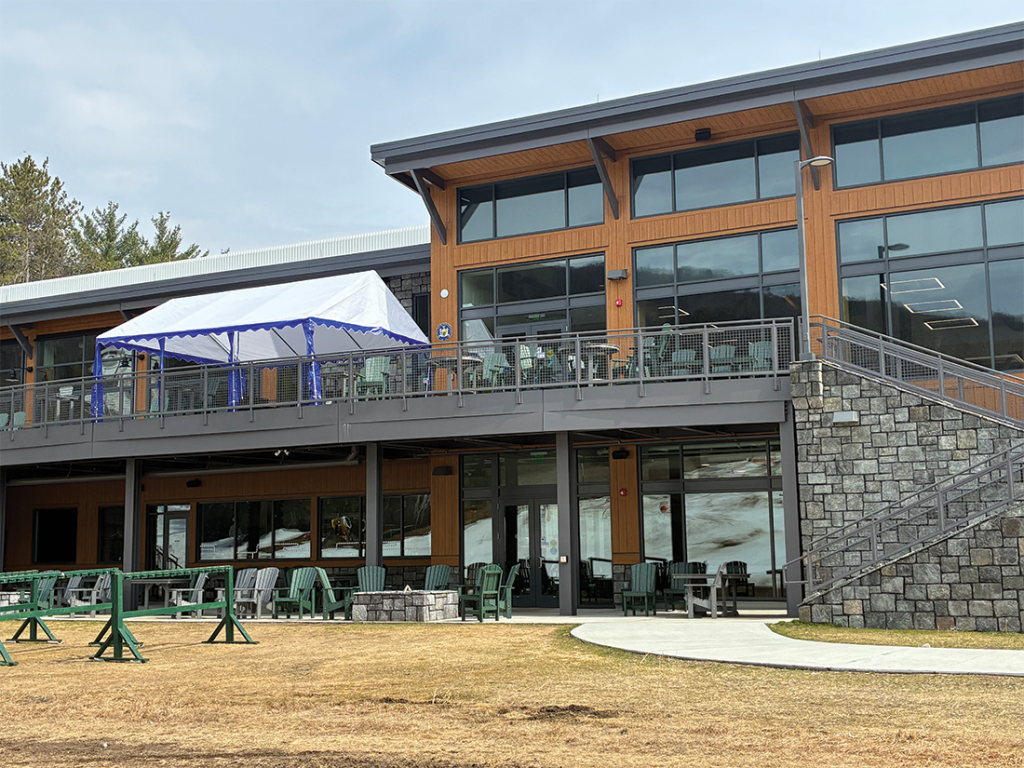
Courtesy Ski Bowl Lodge
By Paul Post
The expected completion this summer of a new $10.1 million sewage treatment plant is spurring transformative economic development in the hamlet of North Creek.
A new Ski Bowl lodge is scheduled to connect to the system when lateral lines are installed this fall, along with the 30-room Public House with two restaurants and the possibility of an affordable housing project that would give people such as Johnsburg Central School teachers a place to live in the community.
“This is exactly how the hamlet of North Creek was zoned by the Adirondack Park Agency more than 50 years ago,” said Town of Johnsburg Supervisor Sterling Goodspeed. “It’s zoned for residential development. The sewer district, which primarily encompasses Main Street and the town-owned Ski Bowl park, is in keeping with that zoning. I think it will attract affordable housing and business growth, particularly restaurants and those things than can feed off the ski industry.”
Plans also call for the opening of a new mountainside alpine coaster ride this summer by the Ski Bowl lodge, making North Creek a more year-round recreational tourist destination.
“It’s designed to target the shoulder seasons and summer,” Goodspeed said. “The projection is that it will bring as many as 40,000 visitors to North Creek.”
Weekender Hotels, which also owns Alpine Lodge in North Creek and other sites in the Adirondacks and New Hampshire, is promoting the Public House, formerly Copperfield Inn, as a base for people to explore and enjoy the region’s many recreational opportunities.
In addition to skiing at Gore Mountain, these include whitewater rafting, tubing, paddling, hiking and rail bike rides, by Revolution Rail, at the historic North Creek train depot where Theodore Roosevelt began his journey en route to becoming 26th president of the United States.
The Public House website says guest rooms “are being fully renovated with a modern Adirondack aesthetic – warm textures, natural light, and a calming simplicity that brings the outdoors in.” Amenities, in addition to two restaurants, include a library, pool courtyard, tennis and pickleball courts, and a fitness center.
“It becomes an incredibly more significant development and more valuable development when you add that final piece of the puzzle, the septic district,” Goodspeed said. “It’s an example of how important the infrastructure can be.”
A vacant, undeveloped parcel just north of the Public House on Main Street “becomes a different parcel of land” ripe for development when there is a municipal sewage district, he said.
Affordable housing is one of the highest priorities, and Goodspeed believes “developers are going to be more incentivized to create more building units.”
The sewage project is “a union of economic growth, benefiting business while at the same time protecting the environment and preserving heritage; a rare triple combination that’s a further indicator of the potential for success here,” he said.
He cited the town’s strong working relationship with the Olympic Regional Development Authority for much of the success already realized.
The Ski Bowl, one of the Northeast’s most historic ski venues, was nonoperational for quite some time before reopening several years ago with an interconnection to Gore Mountain. The Hudson chairlift follows the exact track of a 1940s-era T-bar. From the summit, guests can link to Gore Mountain proper or stay and ski in the park.
Hudson chairlift usage has tripled in the past three years.
Some visitors prefer using the Village lift to stay in the Ski Bowl all day, similar to situations at resorts such as Killington, where people can visit a large resort but enjoy a much smaller area.
“On a Saturday or Sunday this winter the volume of Ski Bowl traffic was astounding,” Goodspeed said. “There were more than 500 cars there some days.”
The treatment plant is on previously vacant land adjacent to Johnsburg Town Hall. Firms working on the project are Jersen Construction Group of Waterford, William J. Keller & Sons Construction Group of Rensselaer, Stilsing Electric Inc. of Rensselaer and Saratoga Springs-based Cedarwood Engineering Services PLLC.
Most funding is from a bond anticipation note and two rural development grants. Warren County has agreed to provide $250,000 per year in occupancy tax funding for 10 years, but only if needed, to keep work moving forward.
The town is in the process of drafting rules and regulations for operation of the system and what new participants must do to connect to it.
“It’s incredibly complicated from an engineering and financial standpoint,” Goodspeed said. “We’re trying to keep all those balls in the air, everyone communicating and getting paid so the system can be finished.”