
 By Paul Post
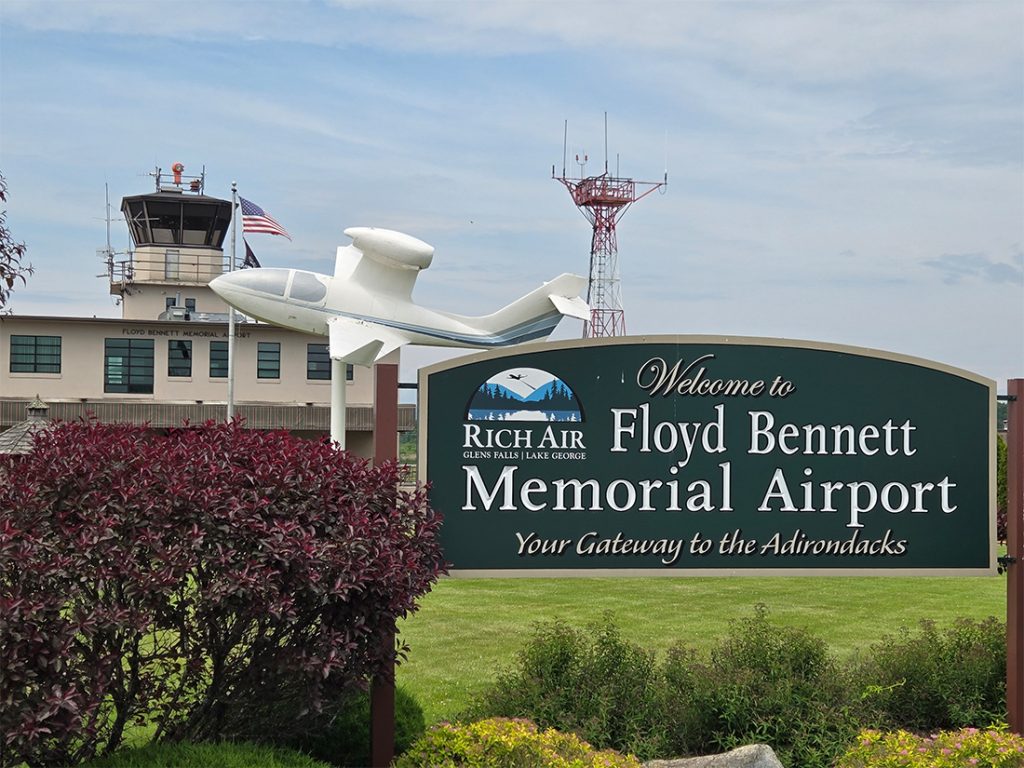
Traffic at Floyd Bennett Memorial Airport is expected to increase from 23,652 to more than 33,700 flights per year over the next 20 years, much of it business and tourism travel that contributes to the local economy.
An airport master plan update, scheduled for completion next year, seeks to identify current and future needs to maintain the site as a valuable regional asset.
Several dozen residents and stakeholders got their first look at the study during a recent public meeting at SUNY Adirondack.
“There’s a perception out there that these airports are only for a certain sector, such as people with small planes or people with a lot of money,” said Steve Bourque, of Binghamton-based McFarland Johnson, an engineering firm specializing in aviation planning. “It’s more than that. There’s jobs at the airport. It’s not only used by corporate executives. It brings in hundreds and hundreds of tourists every year, which brings thousands of dollars to the local economy.”
“It’s also used for search and rescue and law enforcement activity,” he said.
The Adirondack Balloon Festival, one of the region’s largest fall tourist attractions, with more than 100,000 visitors annually, is held there, too.
A 2024 state report says the county-owned airport has a $5.258 million economic impact. Its operating budget for 2026 is $731,917, with anticipated revenue of $400,084 and a net cost to taxpayers of about $331,000.
But the revenue figure does not include income from new solar farms coming online this summer on airport property, bringing in about $130,000.
The master plan update, the first since 2009, is costing $750,000, with 95% of funding from the Federal Aviation Administration and 2.5% each from the county and state. The completed document will provide a blueprint for short-, medium- and long-term airport goals.
“It’s important that we update and develop a future roadmap for the existing airport and future development to ensure that it continues to meet the needs of the community, business, airport users and stakeholders,” said Kevin Hajos, county Department of Public Works superintendent.
The process began with an inventory of air, land and support facilities and an environmental review of the property surrounding the airport’s two runways, which includes significant wetlands that provide habitat to a variety of bird and animal species.
Next, the planning team will identify future facility requirements and alternatives and ultimately make recommendations for implementation.
Rich Air, the airport’s fixed-base operator, has added several new hangars in recent years.
Hajos said short-term plans call for demolishing old T-hangars for small planes and putting up new ones.
In addition to outside traffic, a number of small planes and corporate jets are based there.
“I’m sure there are some flights that go to Florida and all the way out to the West Coast,” Bourque said. “Some aircraft based here have that capability We’re not at the point of knowing whether a runway extension is required yet. That’s the next chapter, the next phase. Aircraft using the airport today are able to take off and land safely and for the most part, get to the destinations they need to get to.”
The airport has two runways. Specific master plan goals include evaluating the longer runway’s performance against FAA planning criteria; protecting land use; addressing airport efficiency and nonconforming conditions; exploring instrument approach improvements; identifying environmental permitting requirements; and establishing mission and vision statements.
Environmental constraints such as noise, air quality and visual impact must all be considered when evaluating development alternatives.
Warren County Economic Development Corp. President Jim Siplon said the airport “is an overlooked and misunderstood asset, economically and otherwise, in our region.”
“If we want to participate in tomorrow’s economy, we have to have the assets that will allow us to do that,” he said. “I think the airport is one of them. The ability to bring business travel to this area directly, as opposed to Albany or Saratoga, creates identity for us and makes it much more likely that firms would consider being here.”
“It doesn’t mean things will happen just because we have an airport, but we have to continue to invest in it as a viable asset that continues to support today’s traffic, personal and business aircraft.”
Investment in Lake George property by wealthy business owners continues to climb at record-setting rates. The airport’s proximity to the lake is an important factor that makes such people want to live here, Siplon said.
“The ability for large business leaders to be here and for them to create cells around their presence here is really important to our future,” he said. “I consider the airport as a threshold asset. You either have one, or you don’t. There are many places in upstate New York that don’t, so you’re automatically disconnected from a piece of the economy.”
“I think the Adirondack Park is going to be one of the great natural resources that people are going to want to have access to for a long time to come,” Siplon said. “The closest place to the southern gateway of the park is Warren County’s airport. That represents a real opportunity for us. We don’t want to give that away to other communities like Saratoga or areas south and north of us.”
The airport is named for Warrensburg native Floyd Bennett (1890-1928), a pioneering aviator and Congressional Medal of Honor recipient credited with making the first flight to the North Pole with Commander Richard E. Byrd in May 1926. It was originally at the present-day site of Queensbury High School on Aviation Road and was moved to its current location in 1941.
A second public meeting, seeking input from area residents, is planned for October.
“The goal ultimately is to have a document that shows all existing and planned future development,” Bourque said.