
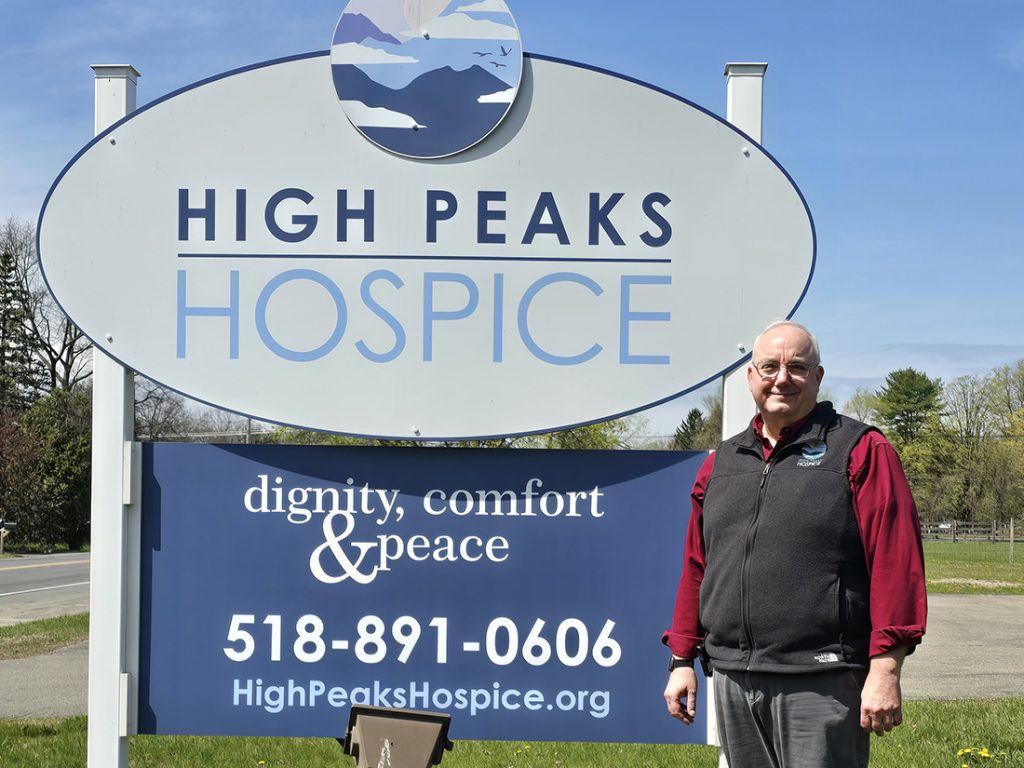
Courtesy High Peaks Hospice
By Ann Donnelly
When people hear the word hospice, they often picture a brick-and-mortar facility. But for High Peaks Hospice, which serves a sprawling six-county region across upstate New York, hospice is not a place; it is a comprehensive service brought directly to the patient.
“We are not a place,” executive director Nicholas George said. “Wherever people are calling home, we go to that home, whether they’re in their actual home, in a nursing home, in assisted living, we go in to take care of them where they are.”
Operating since 1986, High Peaks Hospice has what is likely the second-largest geographic coverage of any hospice in the state. Its territory spans Essex, Franklin, Hamilton, St. Lawrence, Washington and Warren counties. With a staff of nearly 50 employees, the organization cares for individuals who have received a medical prognosis of six months or less to live because of a terminal illness. Age and income are not limiting factors; the hospice has cared for patients ranging from infants to a 106-year-old, and Medicare and most commercial insurance cover the service.
George likens his team’s approach to that of a racing team’s support staff. Family members are typically the primary caregivers, while the hospice staff provides essential reinforcement and medical expertise.
“We’re kind of like a pit crew for a racing team,” George said. “The driver drives up, and we take care of all this stuff, and they get back out on whatever they’re doing.”
This “circle of care” places the patient at the center, surrounded by caregivers and hospice services, which include registered nurses, licensed practical nurses, social workers, spiritual care specialists and volunteers. Their combined efforts focus on managing pain and addressing the psychosocial needs of the family. This includes carefully using narcotics such as morphine to keep patients comfortable without the fear of addiction that might exist in acute care settings. Social workers also play a vital role in navigating complicated transitions, such as moving a patient to a skilled nursing facility, and mitigating familial conflicts that arise during stressful times.
Every week, the staff holds an interdisciplinary team meeting, split between the northern and southern territories, to review every patient. This collaboration often leads to highly personalized care moments. George recalled a hospice doctor bringing his fiddle to play with a patient who was also an avid musician and staff arranging for another patient to leave the hospital to enjoy a final campfire at his newly built dream home.
“The trick is how do we give you the best quality of life we can give you in whatever time is left,” George said.
George brings a unique résumé to his leadership role, which he has held since early 2017, following his service on the organization’s board of directors. A former U.S. Air Force captain, he worked as a systems analyst at the Pentagon before taking a similar IT role at Corning Inc. He later managed a credit union, started a consulting business to develop management skills and ran the Queensbury Senior Center before moving into the nonprofit sector full time.
This blend of military precision, corporate IT experience and financial management helps George balance the dual demands of running a health care nonprofit in a challenging rural environment. In 2023, the organization stabilized its administrative base by purchasing its headquarters building in Hudson Falls, a former house that George says maintains a comforting, noncorporate feel.
“Our first priority is taking care of patients, and then every patient who gets taken care of should feel like they’re the most important person in the world,” George said. “Our second goal is to keep the business going, so we keep doing the first goal.”
Keeping the business going involves robust community engagement and financial planning. High Peaks relies on an annual appeal letter, hospice walks, a motorcycle ride and community-led events such as fishing and golf tournaments. One notable fundraiser involves elementary school students in Tupper Lake, who have spent the month of May raising money for the hospice for the past 15 years.
The nonprofit also depends on volunteers, who are required by Medicare regulations to make up 5% of the hospice’s workforce. Volunteers assist with everything from walking dogs and making admission bags to sitting with patients so caregivers can take a break. The organization also is seeking new board members, particularly those with business ownership or financial backgrounds, to complement its medically experienced members.
Looking ahead, George’s overarching goal is to demystify end-of-life care and encourage families to learn about hospice before they are in a crisis in a doctor’s office.
“Most people don’t need hospice right now, but that’s the time that you want to learn about it,” George said. “Learn about it so that if the time comes when you are ready, you’ll know about it and you won’t be scared about it.”
Ultimately, George emphasizes that his staff’s work is immensely rewarding despite the heavy subject matter. “It is hard, but we’re helping people enjoy life,” George said. “It isn’t all about just the death and dying part. There’s some real positivity to it.”
For more information about High Peaks Hospice, visit https://highpeakshospice.org/.