
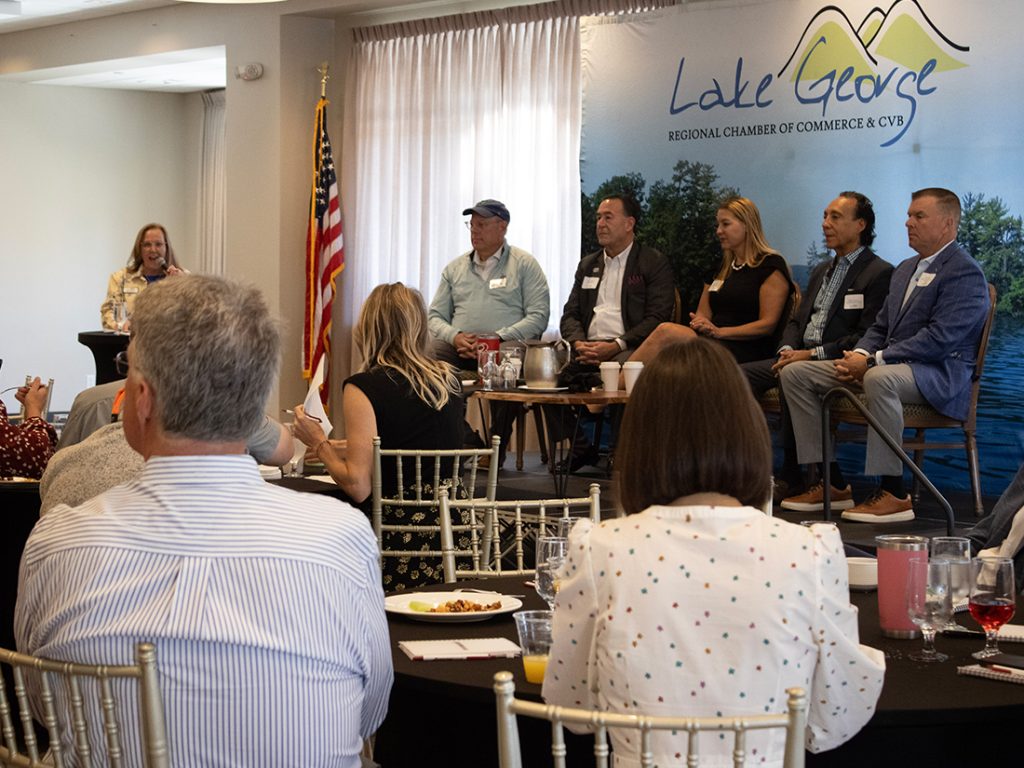
Courtesy Lake George Regional Chamber
By Ann Donnelly
The Lake George region boasts a thriving, multibillion-dollar economy, but sustaining that momentum requires tackling affordable housing shortages, navigating complex development regulations and expanding the year-round experiential economy.
Gina Mintzer, executive director of the Lake George Regional Chamber and CVB, moderated the Spring Economic Outlook Breakfast at the Courtyard by Marriott Lake George on June 16. Themed “Where Tourism Meets Development,” the event featured a panel of finance, real estate and economic experts who provided key insights into the region’s fiscal health.
Jim Siplon, president of EDC Warren County, set an optimistic tone, noting that the region’s economic base is historically and quantitatively spectacular.
“Our economy is a $5 billion GDP economy,” Siplon said. “More than a billion of the $5 billion of value that gets produced here is directly attributed to what we call the experiential economy.”
Siplon, who has led the EDC for six years, added that Warren County is one of the few places in New York seeing a net influx of taxpayers, with 3,000 more people filing returns in 2023 than the previous year.
Dave DeMarco, who has served as president and CEO of Arrow Financial Corp. for the past three years, echoed this sentiment. “It’s been a very stable period for us, for our history, which speaks to the economic growth trends here,” DeMarco said. “We don’t see the high highs or the low lows that other parts of the country do.”
Despite the economic stability, panelists highlighted shifting consumer trends and pressing local challenges. Victoria Duley, executive director of the Adirondack Economic Development Corp., pointed out that inflation is altering how visitors spend.
“The travel market has become a little bit more bifurcated,” Duley said. “The folks of more modest means are really tightening up, and luxury markets are still killing it,” Duley emphasized that small, independent businesses are struggling to keep pace with rising costs, straining the mom-and-pop establishments that define the area’s character.
To offset seasonal fluctuations, Siplon argued the region must leverage its position as the gateway to the Adirondacks and build year-round infrastructure. He cited a recent surge in investment in North Creek following the installation of a new wastewater system. “Within six months of the construction of the wastewater system, more than $25 million showed up in that community,” Siplon said.
Mitch Muroff of Muroff Hospitality Group emphasized that property modernization is the region’s primary opportunity, noting, “The biggest opportunity is repositioning these older hotels and motels, or frankly, tearing them down and building new properties.” He cautioned that financing hurdles make strategic planning essential, warning, “You just can’t go in, buy a hotel, and just fall in love with it and think the numbers are going to work.”
For small, independent properties, Muroff argued that “Management is key.” While he advised hiring experienced third-party management for higher-end properties, this is not feasible at the lower end of the market: “If you”re going to pay a third party a management fee for a small property, you put in too much overhead cost, and the economic viability is just not going to happen.” Despite these operational challenges, he remains confident in the region’s long-term appeal, asserting, “Lake George has continued to sustain itself successfully because of its location, because of its drive-to-market.”
Meanwhile, Dan Davies of Davies-Davies & Associates Real Estate described a historic housing boom, stating, “The market in the last year was really the best I’ve seen in 36 years.” However, he warned that this success has created significant affordability issues for the local workforce, noting, “The consequences are affordability. The average first-time home buyer in the country, pre-COVID, was 33; now it’s 40, and here it’s probably closer to 43, 44. What we need is some affordable housing.”
The housing shortage directly affects local businesses’ ability to staff their operations. Duley added that a lack of midlevel housing forces younger workers to commute long distances, stalling community growth.
Davies also sounded the alarm on potential state legislation, specifically a pied-à-terre tax that could levy a 1% to 10% annual tax on luxury second homes. While the tax is currently applied only to properties in New York City, Davies warned that expanding it to upstate areas would have a massive effect on real estate and could cap the region’s market growth.
For entrepreneurs looking to navigate these hurdles, DeMarco offered straightforward advice on securing capital. “The best starting point, in our opinion, is to talk to a lender before you even get started,” DeMarco said. “We want to be partners, not owners. So, equity contribution is critical. If you don’t have equity skin in the game, the loan stops right there.”
Ultimately, the panel agreed that collaboration among private businesses, lenders and municipalities is the only way to safeguard the region’s future.
“Not every community in New York, in our region, in America is going to solve this problem,” Siplon said regarding housing and development. “But the communities that do better at solving this problem are the ones that will thrive for the next 50 years.”