
Courtesy Paul Post
By Paul Post
Officials are scrambling to help North Country loggers save their livelihoods after Finch Paper LLC’s surprise decision to cease pulp-making operations by year’s end.
Founded in 1865, the company is Glens Falls’ oldest, largest and last heavy industrial employer, with approximately 600 workers.
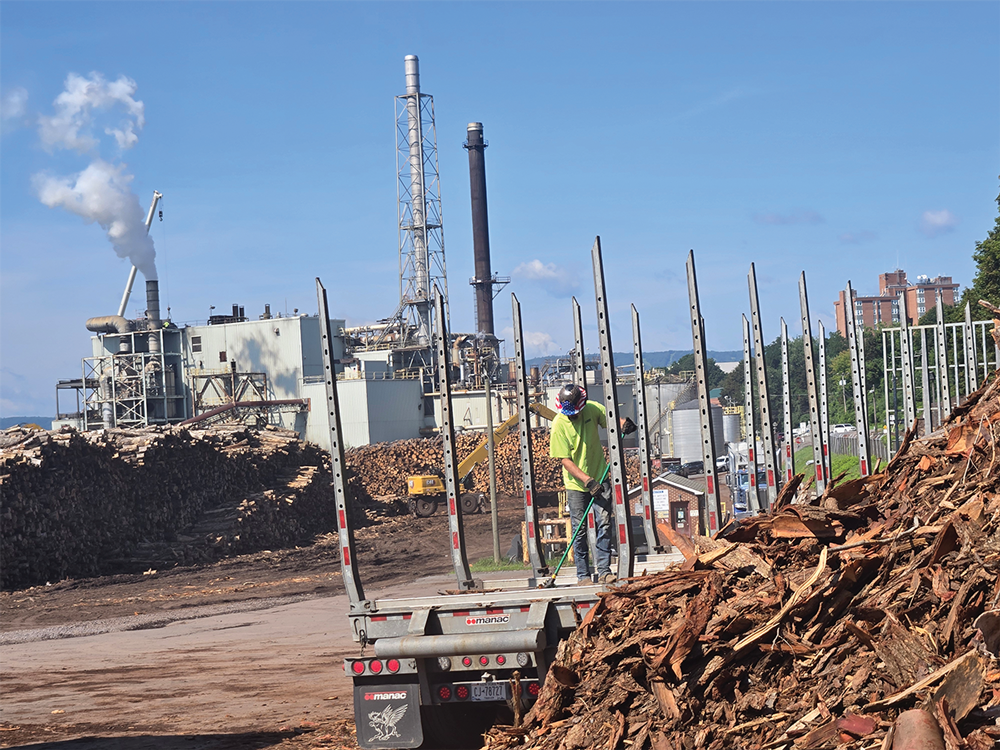
For decades, loggers harvesting Adirondack timber have supplied the mill’s on-site pulp production, a precursor to papermaking. The mill has used 600,000 tons of timber annually, representing 30%-35% of the region’s low-grade pulpwood market, not just New York state.
Finch will instead obtain pulp from outside sources in a cost-saving move it says is needed to remain financially viable.
“What happens when the market has way more wood than it can absorb?” said Courtney Johnson-Woods, executive director of the Empire State Forest Products Association. “It’s going to have a ripple effect. It’s not just going to be people supplying Finch. I’ve had calls from loggers saying this will put me out of business.”
The impact on loggers is one of several far-reaching economic, environmental and public safety concerns. Firms that sell, service and repair their expensive equipment could be hurt, and falling timber demand would reduce income for property owners whose trees are harvested.
“Even restaurants where men gather for breakfast before going out for the day will suffer,” Johnson-Woods said. “It impacts everybody. What’s going to happen to this whole ecosystem of people who are part of the fabric of rural communities?”
Thinning trees also promotes healthy forests. If the practice ceases or declines, forests become more susceptible to invasive species and wildfire during hot, dry periods, such as those decimating the western U.S.
Jim Siplon, president of the Warren County Economic Development Corporation, said Finch Paper’s announcement came as a total surprise. “We didn’t have any advance notice or warning of this decision by Finch,” he said. We weren’t aware of it until they made the announcement.”
“But as soon as they did, we have a good relationship and talked with their senior management team about how we can assist with labor transitions, trying to mitigate any of the impacts,” he said. “One of the first things that came up was a discussion about where timber currently being procured by them, would go. It became clear that there isn’t a full alternative market.”
Finch will continue buying some timber for its biomass cogeneration facility, which converts wood waste such as bark, sawdust and chips into high-pressure steam and electricity. The green energy powers mill equipment and provides heat to dry newly made paper.
“But it won’t come close to compensating for the losses,” Johnson-Woods said.
Some loggers sell exclusively to Finch Paper, while others also have contracts with other buyers. The Forest Products Association has surveyed members for data that might help loggers find new markets, perhaps in neighboring states.
Possible options include a Ticonderoga mill owned by Sylvamo Corp., which spun off from International Paper in 2021, and Colorado-based Lignetics, North America’s largest residential wood pellet manufacturer, with nearly 30 plants, including two in New York state, in Schuyler and Deposit.
Siplon said EDC is working with the Forest Products Association, academic institutions, businesses and nonprofit agencies to identify alternative timber markets.
Logging is one of the few industries within the highly restrictive Adirondack Park that aligns with its core values and conservation mandates.
“We’d like to conduct a speedy study by a reputable third-party organization to assess potential alternative uses for timber,” Siplon said. “Then we could lay out potential investment or incentive ideas the state could partner with us on, in terms of finding active markets for timber. We need to make sure that industry isn’t altered or lost.”
The hope is to develop a strategy quickly enough for the state to include financial incentives in next year’s budget cycle.
Officials throughout the region have cited an ongoing, almost desperate need for affordable housing, without which employers have difficulty attracting workers.
“Things like housing development specific to the region and the park would allow timber to be used for building materials,” Siplon said. “That has the advantage of also sequestering carbon in the timber and keeping it in the park, as opposed to having it go someplace else.”
EDC is also discussing possible microcellulose applications with business and academic leaders. “We’re going to explore all those things,” he said.
Finch makes a variety of uncoated printing, writing and converting papers. Its flagship brands, including Finch Fine and Finch Opaque, are engineered for commercial printing, book publishing, digital inkjet printing and office use.
In a joint statement with the Warren Washington Industrial Development Agency, EDC praised Finch for taking steps to remain solvent and a cornerstone of the regional economy.
The statement says all union and most salaried employees working in pulp mill and woodyard operations will be offered jobs within the paper mill.
“With improvements in its pulp handling, papermaking and energy equipment, Finch will be able to receive and process greater amounts and a greater variety of pulp, the primary raw material in paper,” they said. “This will allow Finch to broaden its mix of paper products and strengthen the long-term sustainability of a business that supports nearly 600 local jobs and pays millions of dollars in taxes.”
Johnson-Woods said Finch Paper’s decision reflects nationwide pulp and paper industry trends. “It’s not just happening in New York, it’s happening all across the country,” she said.
Digital printing and other forms of digital communication have sharply reduced paper sales. Global competition also has a major impact because countries with lower labor costs can sell paper at lower prices.
Johnson-Woods also said newer foreign competitors have more modern, cost-efficient factories than older companies whose mills, in some cases, aren’t up to date. In such cases, buying pulp from outside sources is cheaper than spending millions of dollars to retrofit an older facility, she said.