
Courtesy Paul Post
By Paul Post
Tourism drives about one-third of Warren County’s economy and one of its most important, often-overlooked contributors is The Hyde Collection, a world-class art museum featuring the likes of Rembrandt, Picasso and Degas.
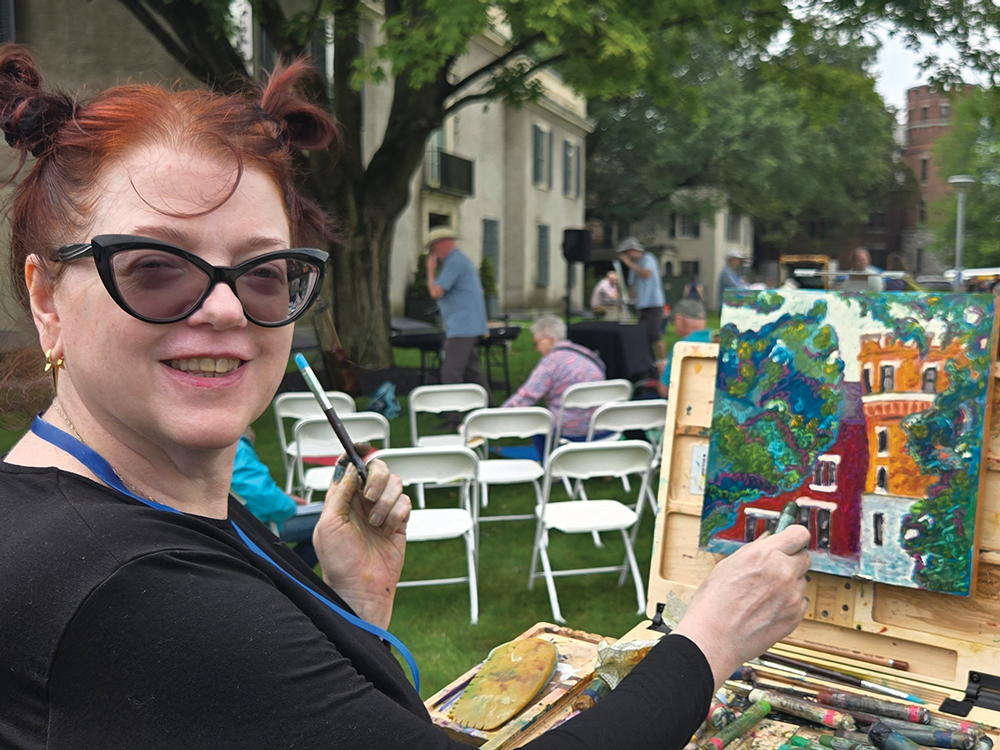
Hundreds of people turned out recently to view paintings created by more than two dozen participants in the inaugural Glens Falls Plein Air Festival.
“It supports the local economy and arts district here,” said artist Fred Holman of Brant Lake. “We come down here and stay overnight and go out to eat, so that’s part of it. But it also brings people to The Hyde to see its works. Put it together with other things going on and all of a sudden you have a big venue to go to, a destination.”
A retired landscape architect, Holman has taken part in numerous plein air festivals in places such as Saranac Lake, Ticonderoga, Keeseville and Canandaigua.
Plein air is a French term meaning outside, on location. It’s a style of painting, tied directly to 19th-century French Impressionism, made famous by Claude Monet, who was dedicated to capturing natural light. It’s done entirely outdoors to catch changing sunlight and weather patterns, which can be challenging for artists.
The Hyde’s July 27-Aug. 2 event gave artists a chance to paint a variety of scenes, from urban downtown Glens Falls to sites on beautiful Lake George.
“I personally love landscapes,” said Anthony Richichi. “I’m right from the Adirondacks so the nature is a really exciting subject. Places like The Hyde and Lake George are world-class locations. It’s a match made in heaven.”
Artist Christopher Smith of West Rupert, Vermont, said he visits The Hyde several times a year, sometimes combining trips with a Thunder hockey game and a stop at Spot Coffee on Glen Street. “The Hyde is an incredible resource for folks up here in the North Country,” he said. “It’s always on the radar. My wife and I come to Glens Falls all the time. It’s kind of right in our wheelhouse.”
In addition to tourism, The Hyde is the kind of cultural “quality of life” feature that corporate executives consider when deciding where to locate a business.
Jim Siplon, Warren County Economic Development Corporation president, said, “Our community is filled with assets that go well beyond what a community like ours would traditionally have. The one that exemplifies that most is The Hyde Collection.”
“The combination of world-class art and the organization that supports it and engages the community, is not only one of the treasures of our place, but an economic driver of its own,” he said.
The EDC, Hyde Chief Executive Officer John Lefner and museum staff feel so strongly about this that they’ve engaged the entire Warren and Washington counties’ arts community in an initiative called Mosaic, which seeks to promote the industry and raise its profile locally.
“The Hyde is the centerpiece because it’s one of the centers of gravity for the cultural and creative economy here,” Siplon said. “We’re in the process of trying to figure out how significant that is. We believe it to be one of the great economic assets of the community. This community and this collection is not only an unusual combination, but a unique combination that we continually have to invest in.”
The Hyde is currently pursuing a $5 million fundraising goal for an ambitious project called the Hyde Center for Arts Education. Hoopes House, on the north side of the museum, has been vacant for decades. Suggestions for its use have ranged from a restaurant, hotel and bed-and-breakfast to razing it for more parking.
“We’re now at a place financially and programmatically to utilize the building to its best ability – expansion of academic program space,” Lefner said. “When we cut the ribbon, you’ll see kids heading inside to roll up their sleeves, to get messy and have an art-making experience with an art educator.”
“You’re going to see artists honing their craft in front of you; art historians offering lectures and workshops to the public. What that will hopefully do is break down some of the hesitation and reservations some people, like myself prior to working here, have about fine art. Hopefully that’s going to ignite a lifelong love of art. For those already indoctrinated in fine art, it’s an opportunity for them to make their own art, further their studies and encourage scholarly colleagues to visit The Hyde.”
A current exhibit, “Wings and Wilderness: Birds and Landscapes of the Northeast”, runs through Oct. 11, featuring more than 40 paintings, sculptures and works on paper from the Museum of American Bird Art at Mass Audubon in Canton, Massachusetts. Each piece, from John Audubon engravings to Andy Warhol silkscreens, is paired with a landscape painting from The Hyde’s vast collection, by American artists such as Winslow Homer.
The exhibit is organized by habitats such as grasslands, water and forests. Presentations about bird calls, bird-watching field trips and nature walks are also planned.
Two other exhibits will open this month.
“Form and Function: The Beauty of Shaker Designs” (Aug. 22-Jan. 10, 2027) will spark regional interest because of the well-known Shaker Village historic site in Hancock, Massachusetts. Shaker furniture is recognized globally today for its simplicity and elegance. The exhibit also explores who the Shakers were, their beliefs and lifestyle.
Also, “Tanya Marcuse: Book of Miracles” (Aug. 15-Jan. 10, 2027) features about 25 works ranging from 10-foot-wide apocalyptic landscape photographs to miniature vignettes of flora and fauna.
This fall, The Hyde will present “Scandinavian Home” (Nov. 7-Feb. 28, 2027), the first exhibition to examine the entangled notions of home and homeland that were central to the art and material culture of Denmark, Norway, Sweden and Finland in the second half of the 19th century.
For more information, go to hydecollection.org.