
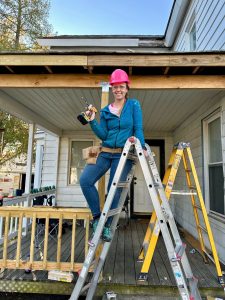
Courtesy Carol Ann Conover
By Carol Ann Conover
In 2009, Andrea Harwood charged $18,500 to a credit card to buy a single-wide trailer in serious disrepair. Newly a single mother of two young children, she had lost her home and was struggling to finish college with little money.
The trailer stood on its own tax parcel rather than a rented lot, giving her reason to believe the property could retain its resale value. Harwood saw potential in a property others might have passed over.
“And I knew I could make it decent,” Harwood said.
She replaced rotted subflooring, repaired burst pipes, patched a roof and taught herself to tile.
“This experience solidified within me that I could figure anything out, no matter what, and that renovating distressed properties is not only very doable, but very satisfying,” she said.
That first renovation launched a real estate business that now owns rental properties across Warren, Washington and Saratoga counties. Based in Queensbury, Casa Bella Development LLC focuses on attainable rental housing and the rehabilitation of existing properties.
In 2012, Harwood bought another home through a pre-foreclosure short sale, renovated it with help from her children and rented out the first property.
“I was hooked,” she said.
Harwood built the portfolio as a sole proprietor before establishing the LLC in April 2026. After working as a financial adviser and in retail banking, she moved into the real estate business full time in January 2023.
“My highest personal value is autonomy,” she said. “I work very, very hard and I had no interest in dedicating my intense work ethic to someone else’s vision.”
Her commitment to housing is personal. Harwood spent much of her childhood homeless, living with her mother and younger sister in a car, tents and shelters in Southern California before the family traveled across the country in a small motorhome. At 16, she secured her own place in South Carolina while working full time and attending high school.
“If you do not know where your next meal will come from and do not know for sure if you have a safe place to sleep at night, it is extraordinarily difficult to focus on anything else in life,” she said.
She later served seven years on the board of the Open Door Mission, a homeless shelter and soup kitchen, and three years as vice president of a Habitat for Humanity board. She also worked for Habitat for a year as director of development and site acquisition.
“It is not lost on me that the work I find the most meaningful is work that solves the most critical problems of my childhood self,” she said.
Casa Bella targets workforce housing. Harwood generally sets rents just below market rates, using the U.S. Department of Housing and Urban Development’s annual Fair Market Rent report as a benchmark.
She also performs much of the renovation work and has financed her projects independently.
“I have done all of my own renovation work with my own two manicured hands, have financed all of my projects by myself and have built this modest real estate portfolio myself,” Harwood said. “Yet I get chronic questions and assumptions about having a husband or boyfriend who is doing all the manual labor and heavy lifting.”
Her advice to women considering real estate development or investment is emphatic: “DO IT.”
“It is my absolute favorite get rich slow scheme,” she said.
Among Casa Bella’s current efforts is the rehabilitation of an older multifamily property into five new apartments intended for households earning 80% or less of area median income. The project has partial support from a state housing grant. Harwood expects to complete the work in early 2027.
“I am excited to be able to provide beautiful brand new apartments at a rate that moderate and lower income renters can reasonably afford,” she said.
Harwood is using subcontractors on the project for the first time while continuing to carry out much of the work herself. She plans a community showcase once the apartments are complete.
She sees opportunity across the region in two- to eight-unit Class B multifamily buildings, which she believes could appeal to renters seeking alternatives to higher-priced luxury units.
She believes that “when times get tough and people need to reduce their living costs, replacing Class A luxury rent with Class B ‘regular person’ rent is a very logical choice that I believe many people will make in the next few years as we all tighten our economic belts.”
“I have predicted 25 of the last 2 recessions, so take everything I say with a grain of salt,” she joked.
Rising acquisition costs have led to more rejected offers, but Harwood continues to look for opportunities to expand. She hopes to develop a 25- to 40-unit apartment complex and is considering the potential of an older commercial building.