
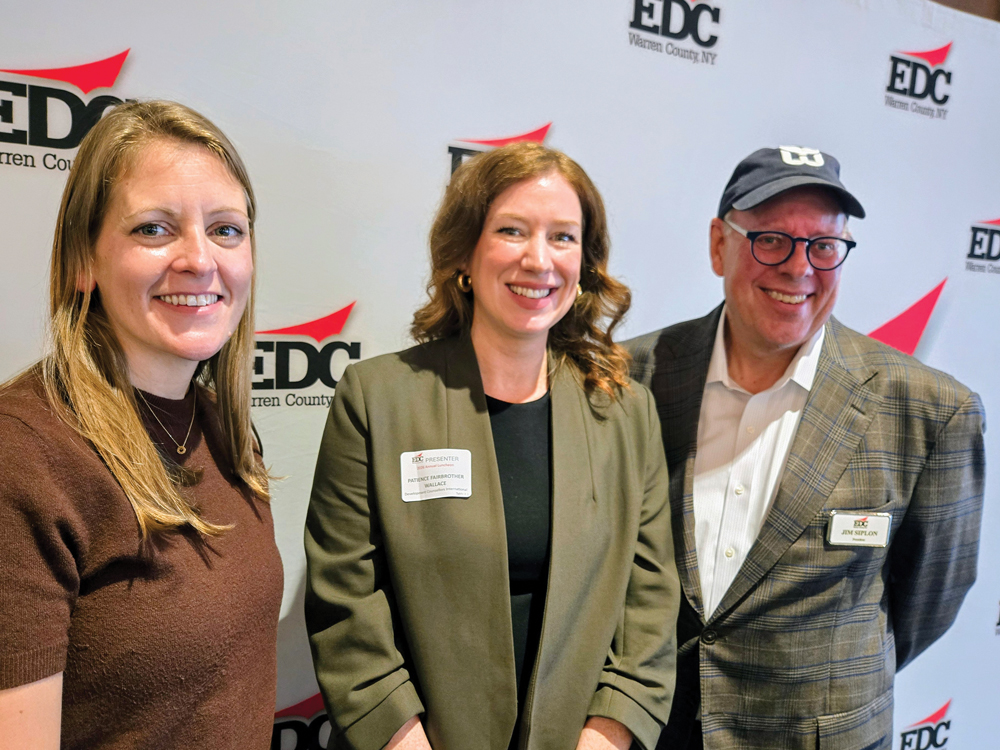
Courtesy Paul Post
By Paul Post
From a business perspective, it might have made more sense for high-tech entrepreneur David Duggal to launch his firm in Silicon Valley.
But he wanted an affordable, safe community with lots of open space for his children, similar to his own upbringing in the lower Hudson Valley.
“I travel the globe and I wouldn’t live anyplace but Glens Falls. I mean it,” said Duggal, EnterpriseWeb founder and holder of multiple patents related to software and computing systems.
He is an example of the type of person regional officials are trying to attract for sustainable growth in a rapidly changing 21st-century economy. Several large employers, such as Glens Falls Cement Company, Essity paper and Great Meadow Correctional Facility, have closed in recent years, and Finch Paper Company’s elimination of pulp-making operations has significantly affected North Country loggers.
In response, local business and government leaders must promote the area as a place where entrepreneurs want to invest and live.
That was the message keynote speaker Patience Fairbrother Wallace delivered to roughly 200 people at Warren County Economic Development Corporation’s (EDC) recent annual luncheon at Fort William Henry Resort’s Carriage House. She is senior vice president for talent attraction at New York City-based Development Counsellors International, which specializes in marketing cities, states and regions.
“Communities that succeed will be those that understand not only where talent is moving, but why people move, what keeps them rooted and what ultimately makes a new place worth calling home,” Wallace said. “You can’t just get people excited to move here. You can’t sell them a bill of goods. You have to build the kind of community that’s able to receive them and also retain them.”
“How do we package the assets we have and continue to make this a better place to live for current and future residents,” she said.
Warren County is located between the Adirondacks, a major outdoor recreation destination, and the nearby Capital Region, an economic center.
“We have business, restaurants, schools, healthcare; we have everything that it takes to make a community feel like home,” said Melanie Fronhofer Weber, EDC’s new board chair. “People feel like they can grow with us.”
Sometimes-overlooked features, such as a vibrant arts community and a professional sports franchise, the Adirondack Thunder, also are important quality-of-life assets.
Lower Adirondack Regional Arts Council Executive Director Phil Casabona described a Mosaic initiative, supported by the EDC and Warren Washington Industrial Development Agency, that has brought together more than 100 local arts organizations to strengthen and promote their presence.
“This region offers exceptional lifestyle value,” Wallace said. “It’s not just about affordability. It’s about what you get for what you pay here.”
Before the pandemic, most people who moved did so to advance their careers. That is no longer the case.
About half of respondents to an in-depth survey said quality of life is now a top priority. People also are more concerned about living close to family and friends and having the ability to work remotely.
Communities therefore need critical infrastructure, from streets and highways that improve commute and delivery times to broadband that enables business in rural areas.
“Feasibility is the new gatekeeper for relocation,” Wallace said. “People aren’t just asking, do I want to move? They’re asking, is it possible?”
The main barriers to relocation include moving and housing costs, distance from family, economic uncertainty and career risks. What other jobs are available if the position someone moved for does not work out?
Attracting large new employers is difficult and time-consuming. That makes it especially important to attract talented individuals, such as Duggal, who might start a business or bring an existing one to the area.
“Talent is becoming a defining factor for whether a community grows,” Wallace said.
Declining birth rates and an aging population have reduced the talent pool, making it harder to compete for such people.
“You don’t need to be all things to all people,” Wallace said. “This region isn’t going to be for everybody. But it’s going to be for a certain sector of people who either have mobility or an interest in it. You’re absolutely unparalleled with outdoor assets. Nearly no other place in the world can compete with the Adirondack Park, Lake George, four-season outdoor recreation opportunities.”
“But don’t target everybody,” she said. “It’s about targeting people who are actually more apt to move.”
People who have relocated previously for work are more apt to again, as are people with social connections to a place. “Finding those people is key,” Wallace said. “This region is very fortunate to have spent decades building a sense of place. You aren’t starting from zero.”
Many people who grew up visiting or vacationing in Lake George have eventually moved there, often becoming business owners.
“Today’s visitor is tomorrow’s talent,” Wallace said. “Visitors are more apt to relocate. This is especially relevant to a region like this that such a strong tourist aspect.”
In today’s digital age, the internet and social media can play a major role in shaping perceptions of a place. Word of mouth from people sharing positive experiences is important, too.
Some people who grew up in Warren County are ready to return, settle down and raise families after living in larger cities.
“These are all ripe for the picking,” Wallace said. “Have information available and be ready to answer their questions about what local schools and healthcare are like. That could make the difference about whether or not you’re on their short list of places to move to.”
EDC President Jim Siplon thanked state and local officials attending for their efforts to promote the economy. Student representatives from every school district in the county were invited as the EDC seeks to engage them and develop future leaders.
Siplon said economic development officials from Warren, Washington and Saratoga counties meet frequently to collaborate on attracting new businesses and supporting existing ones.
“The future of [Warren County] is tied to the future of this entire region,” Weber said.