
Courtesy Paul Post
By Paul Post
Washington County officials are baffled by the state’s apparent undermining of its own environmental program and local economic development initiatives.
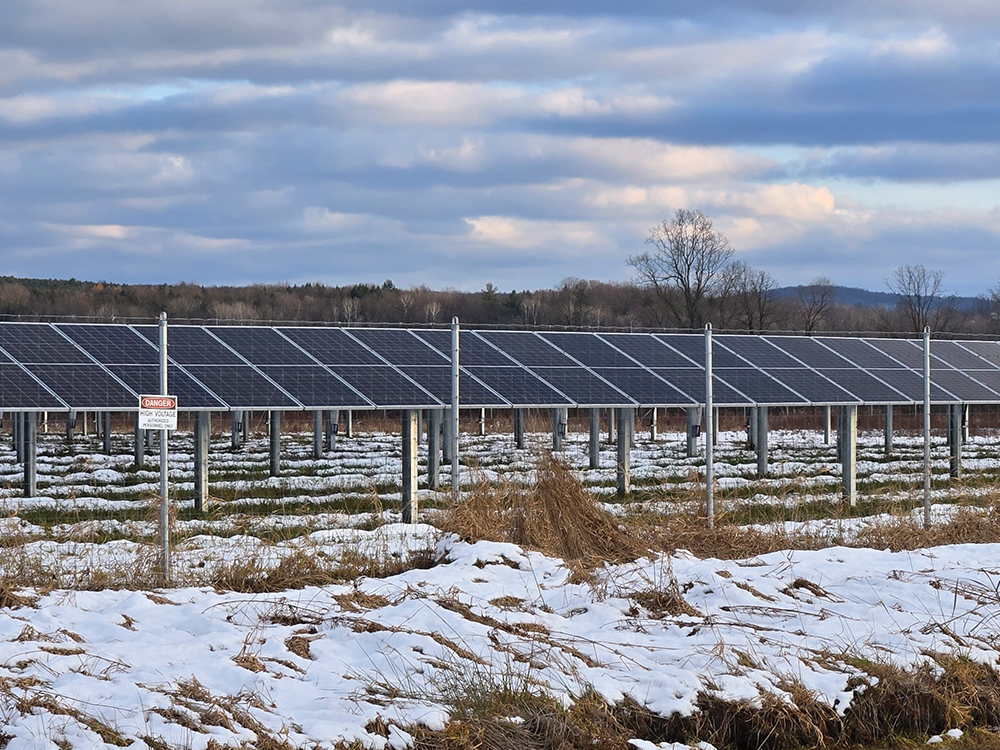
Montreal-based Boralex has plans for a100-megawatt solar project covering 567 acres surrounding a DEC Wildlife Area where rare grassland birds nest and breed in southern Fort Edward.
The state is fast-tracking large-scale solar and wind projects with a goal of having all electricity coming from renewable energy sources by the end of this decade. But projects such as this might come at considerable cost.
The endangered short-eared owl and threatened Northern harrier are among many species that need wide open grassland to survive. These two birds alone attract large numbers of naturalists and birding enthusiasts, contributing to the county’s ongoing tourism efforts.
The site in question is about two miles from the Alfred Z. Solomon Grassland Viewing Area on County Route 42 where people come to see and photograph scarce species. A separate, fairly large solar complex has already been built just beyond the Viewing Area’s eastern boundary.
“It’s absurd,” said county Board of Supervisors Chairman Robert Henke, of Argyle. “We spend all kinds of funds on a Viewing Area where people can set up giant camera lenses. What you see when you look out from there is a big solar facility.”
Henke, a former DEC employee, recalled writing an article for The Post-Star about the local sighting of a Northern Hawk-Owl. “Three days later we had license plates from 38 states in the area,” he said. “It was astonishing. Talk about a potential economic driver.”
The state’s apparent support for the Boralex project could wipe this out, he said.
“The conflict within state government on the thing is just so amazing,” Henke said. “It’s just baffling to me.”
But Dennis Suarez, Boralex vice president for communications, said the project has already been scaled down about 200 acres from its original proposed size and that it’s been designed to reduce impacts on grassland bird habitat and agricultural land.
The use of agland for solar complexes is a concern across the state.
If approved, Boralex hopes to start installing solar panels in Fort Edward late next year and have the complex operational in 2027.
“We need power,” said Laura Oswald, county Economic Development Coordinator. “We have companies leaving New York state because the cost of energy is incredible. Your personal residential bills are increasing exponentially. There has to be a solution. Solar will never solve all of the world’s energy problems, but it is a contributor.”
“Having said that, there’s a cost. There’s always a cost,” Oswald said. “I don’t think there’s any doubt that covering close to 700 acres of what is basically wildlife refuge for endangered species won’t have an ecological impact. It has to. That ecological impact will trickle down to tourism impact. People who are into birding will travel all over the world to look at species. We actually have tours that come from Europe and overseas.”
“The bigger concern is that New York State, as they’re working with solar projects has created a property tax assessment formula meant to keep the cost of solar development down,” she said. “That assessment impacts the value of parcels and what we get at the county. At this point, even the low assessments that have been determined are viewed by the state as being too high. So the state has conveyed upon New York Power Authority the ability to own and operate large-scale solar facilities.”
The first-ever solar project turned over to NYPA is a smaller one in Fort Edward near the border of Greenwich.
“When the state owns and operates a facility, it’s non-taxable,” Oswald said. “If that were to happen to the 30-plus parcels this huge (Boralex) facility is located on, that immediately removes tax revenue to the county. We need power, there’s no doubt about that, but is this going to affect us? Yes it will.”
The state Department of Agriculture & Markets is closely watching ongoing solar project development. “We certainly support our state’s renewable energy agenda, but with the understanding that we must balance the importance of furthering these efforts with the protection of our farmland, particularly our prime soils,” spokesperson Jola Szubielski said. “With renewable energy installations expected to continue for the foreseeable future, it is important that we work together on the opportunity to integrate renewables into our working landscapes with minimal impact to local communities that have strong economic ties to agricultural production.”
“We are actively collaborating with our partners at NYSERDA and the Public Service Commission through a memoranda of understanding and technical working groups to avoid, minimize, or mitigate impacts to actively farmed land, and to refine siting approaches for higher-quality soils,” she said. “We are also optimistic about the new research projects NYSERDA recently awarded that will help us gain a better understanding of how a farm business and solar can co-locate, and allow us to learn best practices along the way to ensure agrivoltaics are a beneficial option for our farmers moving into the future. We look forward to seeing these innovative projects and accompanying research across the state take shape.”