
Courtesy SLICFiber
By Paul Post
From Watertown to Waterford, a fast-growing fiber optics firm is giving the region a new alternative for internet and phone service, with television expected to follow soon.
After launching in northernmost New York, St. Lawrence County-based SLICFiber started moving south to Warren, Washington and Saratoga counties and is now in markets such as Lake George, Glens Falls and Ballston Spa.
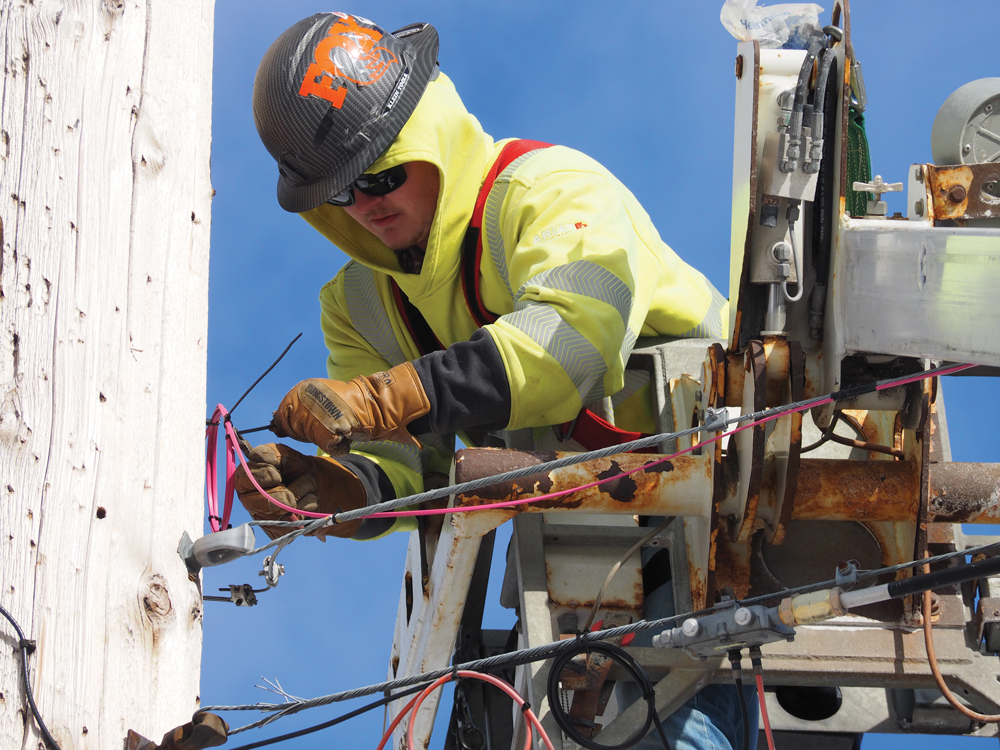
On Feb. 4 – World Cancer Day – it made a highly visible entry to Mechanicville by installing the first-ever pink fiber-optic cable with plans to donate $25 to local charity for every residential and commercial connection.
“We’ve always been a very community-based organization,” CEO Kevin Lynch said. “Cancer affects a lot of people. This will help families with things like travel and lodging.”
Mechanicville-Stillwater Chamber of Commerce is the first “Pink Drop” customer. Plans call for working with local officials to make the #FiberofHope initiative available in SLICFiber’s entire service area.
Warren County Economic Development Corporation President Jim Siplon said fiber optics is a huge economic game changer, especially in the Adirondacks where broadband has been extremely limited in many places.
“First, it’s a clear sign of investment in our area,” Siplon said. “When people are willing to spend millions of dollars betting on the future of this place and bringing the most current technology to bear, that’s a good sign for all of us.”
“Second, it provides competition, which provides better service at better rates, whether you adopt to this carrier or not,” he said. “Third, fiber has almost unlimited capacity and much greater speed. The current technology was based on usage that we overwhelm every day because in the 1980s nobody thought as many people would be on the network at the same time, as exists today. But fiber networks can handle it.”
A big part of the region’s overriding economic development strategy involves attracting highly talented, skilled people who can work wherever and whenever they want to but need to be sure there’s a connection to the rest of the world.
“This puts us on the map,” Siplon said. “It says, you can do whatever you do in Brooklyn, here. That’s good for everybody.”
“A lot of people for a lot of years have been frustrated that they haven’t had a choice,” Lynch said. “So we’re providing a choice. As in most industries, when you bring in competition you get better results at lower cost. That’s what we’re striving for.”
“We are a pure fiber optic network, so from our equipment right into the home is all fiber optics and it’s a symmetrical service so your downloads and uploads would be the same,” he said.
SLICFiber began serving northern Warren County towns and hamlets such as North Creek, Thurman, Stony Creek and Athol several years ago, making it possible for small and home-based operations to conduct business without broadband.
Until recently, the firm’s entry to places such as Glens Falls and Hudson Falls has been relatively quiet because the process of getting fiber optic cable on poles has taken longer than expected. But Lynch said customers will soon start seeing direct mail, digital ads, social media and billboards, letting them know “there’s now a choice and an alternative in the area.”
“The cost of building rural broadband has more than doubled in the past decade,” Lynch said. “A big portion of that is getting onto existing poles. Those costs have gone from $10,000 to over $100,000-per-mile now in some cases. It’s just absolutely exploded in cost.
“It really comes down to density,” he said. “There’s a breakeven point of 10 to 12 homes per mile. Once you get below that density it’s very hard to make it economically sustainable.”
The service SLICFiber has provided to lightly-populated towns such as Johnsburg was partially funded by state grants. “Otherwise it’s not economical to build in those areas,” Lynch said.
But Siplon said total broadband coverage has grown from 70 percent to about 95 percent of Warren County addresses since SLICFiber came on the scene. “Of the less than 2,000 addresses not served by a modern broadband standard, probably half of those are seasonal properties or those where this is something that isn’t desired,” he said. “I don’t know if we’ll ever get to 100 percent, but we’re a lot closer to it than we’ve ever been.”
Lynch said SLICFiber employs 110 people, a number that’s doubled in the past two years alone, and it continues to hire new workers as its territory expands.
“I became a believer in their service just because it was so reliable (during COVID),” Siplon said. “We’ve been allies and supporters ever since. They’re in the process now of starting to turn up service here in our area – Glens Falls, Queensbury, Lake George.”