
Courtesy Paul Post
By Paul Post
Maple producers in Warren, Washington and Saratoga counties are gearing up for Open House Weekends to celebrate the sweetest time of year.
With more than 2,000 sugar makers statewide, New York is the nation’s second-leading producer behind only Vermont, and the industry generates an annual economic impact of about $141 million.
In Warren County, Thurman Maple Days plays an especially important role in generating tourism as the ski season winds down before the onset of summer vacation months.
“We’ve kind of become known as the Maple Capital of New York,” said Randy Galusha, owner of Toad Hill Maple Farm. “What we’re practicing is agritourism. People get to see our farms and learn about the history of maple sugaring. It’s one of the shoulder seasons when not a lot of other things are going on.”
The Lake George Chamber of Commerce says off-shoulder hotel bookings increased dramatically last year, reflecting ongoing efforts to make the region a more year-round tourist destination. According to Visa Analytics, 45 percent of visitor spending in 2025 occurred during shoulder-season months, matching peak-season performance and signaling a more balanced annual tourism cycle.
Maple Days is one of many events contributing to such trends, and interest is expected to be especially strong this year. “It’s been a long, cold winter,” Galusha said. “People are suffering from cabin fever. So if we get a nice sunny day people will come out in droves. They’re just looking to get outside and do something. We take them on wagon rides through the woods; they get to see animals at other farms.”
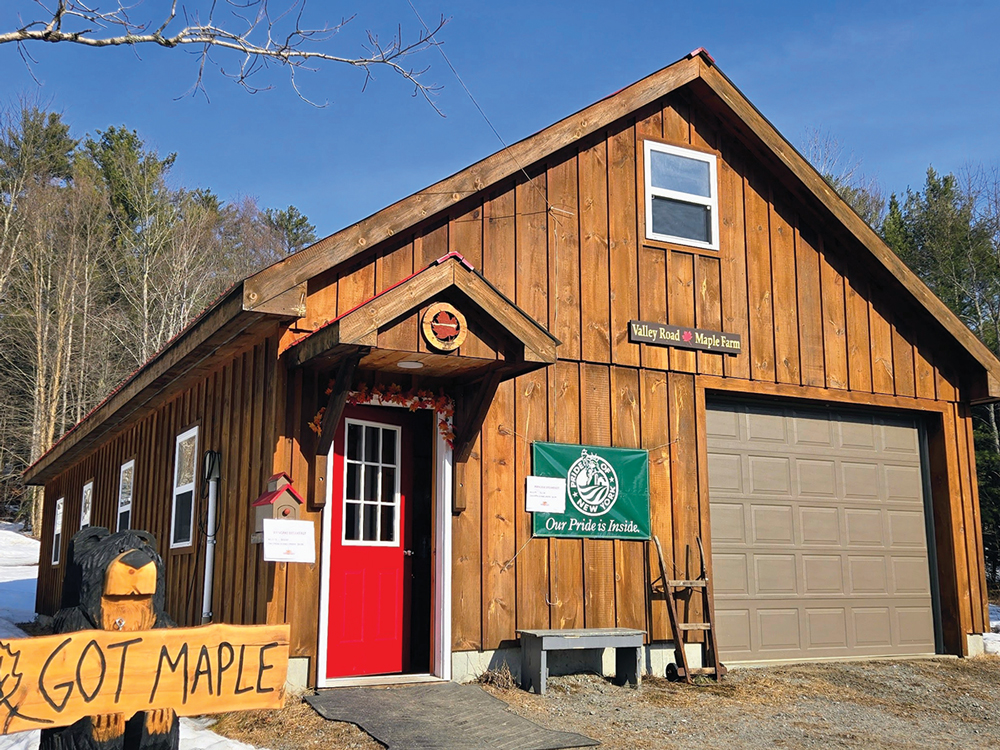
Maple open house events in Thurman are held three consecutive weekends from March 14-15 to March 28-29. The townwide celebration is highlighted by a self-guided tour to five different producers including Valley Road Maple, which holds pancake breakfasts; Nettle Meadow Farm, renowned for its award-winning cheese; Martin Lumber; and a Maple Craft Fair.
“It’s really grown tremendously,” Galusha said. “Last year we really knocked it out of the park in terms of attendance and sales.”
This year’s extremely cold, snowy winter has been in stark contrast to recent milder seasons and is good for production, said Helen Thomas, president of the New York Maple Producers Association.
“We all prefer a winter like this one as the snow cover and cold temperatures are good for the trees,” she said. “But as maple producers usually say, We’ll give you our prediction in May!”
Galusha explained that deep, freezing temperatures tend to increase sap’s sugar content. On the flip side, cold weather keeps sap from running, which hinders production.
“It’s hard to get your shelves all stocked in anticipation of maple weekends, but we’ve been working on it,” he said.
Ideal sugar-making conditions are warm days with temperatures in the 40s and 50s followed by cold nights down to about 25 degrees. This cycle creates pressure within trees that makes sap flow.
A deep snowpack such as this year’s helps cool things down at night.
“If we had bare ground and 60 degrees I’d really be worried,” said Tim Monica, a fifth-generation producer at Maple Valley Farm in Corinth.
Business has been so good the past few years that he plans to acquire two new sugarbushes this summer and more than double his operation from 2,600 taps to nearly 6,000 taps. “After COVID, everybody’s been going back to more natural things, anything they can get from a local producer,” he said.
In addition to on-farm sales, Maple Valley syrup is sold at popular outlets such as King’s Dairy in Northumberland, Smith’s Orchard Bake Shop in Charlton and Saratoga Winery in Saratoga Springs, whose chef uses maple in a variety of dishes. Monica also sells products at the Saratoga County Fair and farmers markets in Glens Falls, Saratoga Springs and Chestertown.
In addition to its tourism benefits, maple production is especially important for rural communities by providing additional income to smaller, family-run operations.
Monica runs Maple Valley Farm with his daughter, Abigail, and his brother, Scott. He learned the business from his late father, Don, who began making syrup as a young boy with buckets hung from trees and worked at night to boil sap with light from kerosene lamps.
Monica still uses a wood-fired evaporator but has added reverse osmosis technology that removes much of the sap’s water content. This reduces the time needed to boil sap into syrup so he does not have to burn as much wood.
Dave Campbell runs Mapleland Farm, which has 19,000 taps on more than 600 acres in Salem, Washington County. He is also president of the roughly 50-member Upper Hudson Maple Producers Association.
The industry in New York is growing 7 percent annually, fueled by increased demand both domestically and globally from countries such as China and Japan. New York has produced more than 800,000 gallons of syrup in six of the past eight years including a record-high 846,000 gallons in 2024.
Production has more than quadrupled since 2001 (193,000 gallons) thanks in part to state funding for marketing and research and legislation that has opened some state-owned land to sugaring.
Taste NY markets promoting maple are set up at key locations throughout the state this month including the Adirondack Welcome Center between Northway exits 17 and 18 northbound. Maple samples will be available there from 11 a.m. to 1 p.m. each Thursday in March. The Welcome Center will also host a “From Sap to Syrup” event from 11 a.m. to 4 p.m. Friday, March 20.
Visitors may sample maple products and there will be educational and interactive displays. Samples of maple lattes and locally made maple hot cocoa will be sold on site.
“Marketing is working,” Campbell said. “People are using that natural sugar instead of artificial sweetener.”
About 25 percent of his farm’s syrup and value-added products such as maple creams and candies are sold locally. The rest goes to numerous retail outlets such as gift shops, orchards and restaurants including several of New York City’s finest dining establishments.
“New York continues to be a top maple producer in the U.S. and our producers continue to make some of the finest, most innovative maple products in the country that contribute greatly to our economy,” state Agriculture Commissioner Richard Ball said. “I encourage New Yorkers to find a nearby, local producer hosting during Maple Weekends and join in this timeless tradition. This is truly one of the best times of year, as we gather with our communities across the state to support our maple producers.”
For a complete listing and more information about Maple Open House events go to: https://www.mapleweekend.com/.
For information about Thurman Maple Days go to: www.thurman.com.