
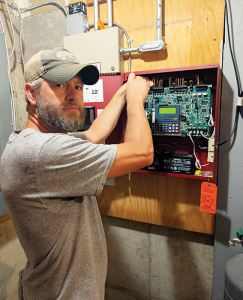
Courtesy New York Fire & Security
By Rod Bacon
According to FBI crime data, burglary, defined as unlawful entry into a structure with the intent to commit a crime, has historically accounted for between 1.1 million and 1.4 million reported incidents per year in the United States. Commercial properties, including retail establishments, offices, warehouses and service businesses, account for approximately 35% to 40% of that total, suggesting roughly 385,000 to 560,000 commercial burglaries occur annually in the U.S.
Statistics compiled by the Office of Justice Programs, a component of the U.S. Department of Justice, show that commercial buildings without security systems are 4 to 4.5 times more likely to be burglarized than those with active alarms or surveillance.
Glens Falls-based New York Fire & Security has been helping entrepreneurs prevent theft from and damage to their buildings since 1946. The company provides state-of-the-art systems that address any type of security breach or fire hazard to a business.
“Security has a common theme, whether it’s for an office, warehouse, or retail business,” said Vice President Seawn Eggleston. “It’s about protecting property and the people in the building.”
When he does an initial assessment for a client, the vulnerability he most often encounters is door access. He said there have to be protocols in place to control who is entering and exiting a building. A very effective solution is installing a door access system consisting of card readers. A digital card can be assigned to an employee’s cell phone so they don’t have to have a physical card. That allows them access because they have credentials. The credentials can be customized to allow them access to only certain parts of the building or entry only at certain times. If an employee leaves the company, the privilege can be easily canceled. For vendors or regular visitors to the business, the cards can be tailored to allow access only during certain times or through certain doors. In all cases, a trackable record of people accessing the building is created.
In addition to door access, there are cameras, which, according to Eggleston, are often the first thing customers ask about.
“Cameras are an important part of a complete security installation, but they must be strategically placed,” he said.
He explained that placement and elevation are key. Cameras in entryways are important, but they shouldn’t be placed too high or all they capture are the tops of people’s heads, thus not getting a good identification of the intruder.
As an interesting anecdote, Eggleston said that thieves will often change articles of clothing to hide their identities, but they almost never change their shoes.
“An intruder might change his shirt or put on different pants after committing a burglary but will usually keep the same shoes on, so it’s a good idea to place cameras so they will capture the feet,” he said.
Eggleston recommended having all security systems checked by a professional at least once a year to ensure they are functioning properly. Camera lenses should be cleaned, the network video recorder (NVR) evaluated, door contacts checked and all batteries given a load test.
The price of a security system varies widely depending on the size of the building and specifically what the client wants monitored. An adequate system can be installed for approximately $6,000, but if a highly sophisticated one is required, the cost could reach $30,000.
New York Fire & Security is an Underwriters Laboratories (UL)-listed alarm dealer, which means that for many of its customers, monitoring is not done locally. The company contracts with Emergency 24, a firm that has several monitoring stations throughout the country. If something happens to one monitoring station, the calls are automatically rolled over to another one without interruption.
“A lot of our customers require that we have redundancy built in and this service provides that,” Eggleston said.
The company also offers Total Connect on the majority of its panels, which allows the owner of the system to arm or disarm it from anywhere. In addition to business owners, this can be advantageous to homeowners.
Eggleston cited the example of a customer who lives at a distance but has a vacation home on Lake George. He can access that home’s security system from his electronic device, see what is happening and control the situation.
“Obviously, the police or fire department will show up but the homeowner can see what’s going on in real time,” he said.
In addition to break-in protection, the company provides environmental monitoring of things like temperature, water spillage and dangerous gases. Eggleston noted that these systems are installed primarily in warehouses and medical facilities where records might be stored in a basement or vaccines in a secure room.
Most of these applications are installed by the company’s fire and life safety experts.
The company’s service regions include Plattsburgh, the Adirondacks, Lake George and the Albany metro area.
For more information about New York Fire & Security, go to nyfireandsecurity.com.