
Glens Falls Business Journal
By Harry Weinhagen
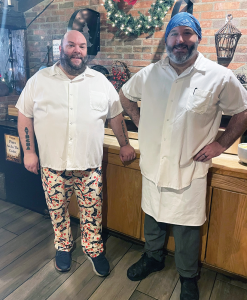
When I sat down with sous chefs Terry Fisk and Andrew “Andy” Camp at the Log Jam, one number stood out: The kitchen had recently served 1,160 guests on a single Saturday. I wanted to know how they divided the work now that longtime executive chef Rod Russo had stepped back. The answer kept coming back to consistency, from the way a steak is cut downstairs to the way a server relays an order upstairs.
The kitchen day starts at 8 a.m. About 30 people work in the kitchen on an average day. Terry usually runs prep downstairs, and Andy usually works the dinner line upstairs. Before the first diners arrive, the crew cuts steaks and fish, readies the sides and stocks the salad bar. When either chef takes a day off, the other can step in.
Both chefs know what it’s like to work their way through that kitchen. Terry has been at the Log Jam for 21 years. He started in the prep room, moved to the salad bar and then worked the line. Andy has been there for 16 years. He started washing dishes while taking culinary classes. He moved into prep before he began cooking dinners and eventually running the line.
One of the chefs estimated that about 98% of what goes on a plate is prepared at the restaurant. That includes the salads, custom-cut steaks and chops, and seafood the crew portions in-house. One chef said a steak Russo cut 25 years ago would look like one he cuts today. That detail helped me understand why the cuts matter upstairs. When portions come to the line cut to the same size and thickness, the cooks can judge how long they need on the grill, even with a row of orders waiting.
I asked about the salad bar because it’s one of the first things I think of when someone mentions the Log Jam. One of the chefs told me that a traveler at a South Carolina airport spotted his Log Jam shirt and brought up the salad bar. Back in Lake George, keeping it stocked means cooking pasta, cutting vegetables and making most of the dressings in-house. The crew also rotates some of the salads with the seasons. A tomato and cucumber salad went on the bar when the produce was available, and the response gave the chefs a reason to bring it back. The dinner menu leaves room for change. The main steaks stay, while six featured entrees change about once a month. The chefs sit down toward the end of the month to compare ideas and see what their suppliers can get. A fish that’s readily available one month may be harder to get the next. Sometimes they start with a dish Russo developed and make a few adjustments. Sometimes they try something new.
Russo still works two days a week and helps with menus. When I asked what he was teaching them now, the conversation turned to running the restaurant as a whole. Both men had spent years working a line. One lesson Russo passed on was how to take a dish that works in a test and figure out what it will take to serve it through a busy shift.
That kind of consistency also comes from keeping people. Andy told me that another cook, Mike, had been there 18 years and that many of the servers had been there 25 years or more. Those years matter on both sides of the kitchen door. The cooks learn how the others work the line, and the servers know whom to ask when an order needs clarification. When the dining room fills up, that familiarity helps keep a small question from holding up a table’s dinner.
I asked what they watch for when orders pile up. Andy talked about speed and making sure the same dish looks the same each time it leaves the kitchen. Terry gave me a concrete example. When a special request comes in and the ticket leaves a question, he needs the server to come back and clarify it. That lets the cooks get the request right while the rest of the order keeps moving.
Near the end of our conversation, Terry told me both his daughters work at the Log Jam. That day, one was on the salad bar and the other was downstairs in prep with him. Those were two of Terry’s own stops on his way to running the kitchen. Andy had talked about serving 700 dinners in a night. Part of what makes that possible starts downstairs, where a new generation is learning the same work Terry started out doing.