
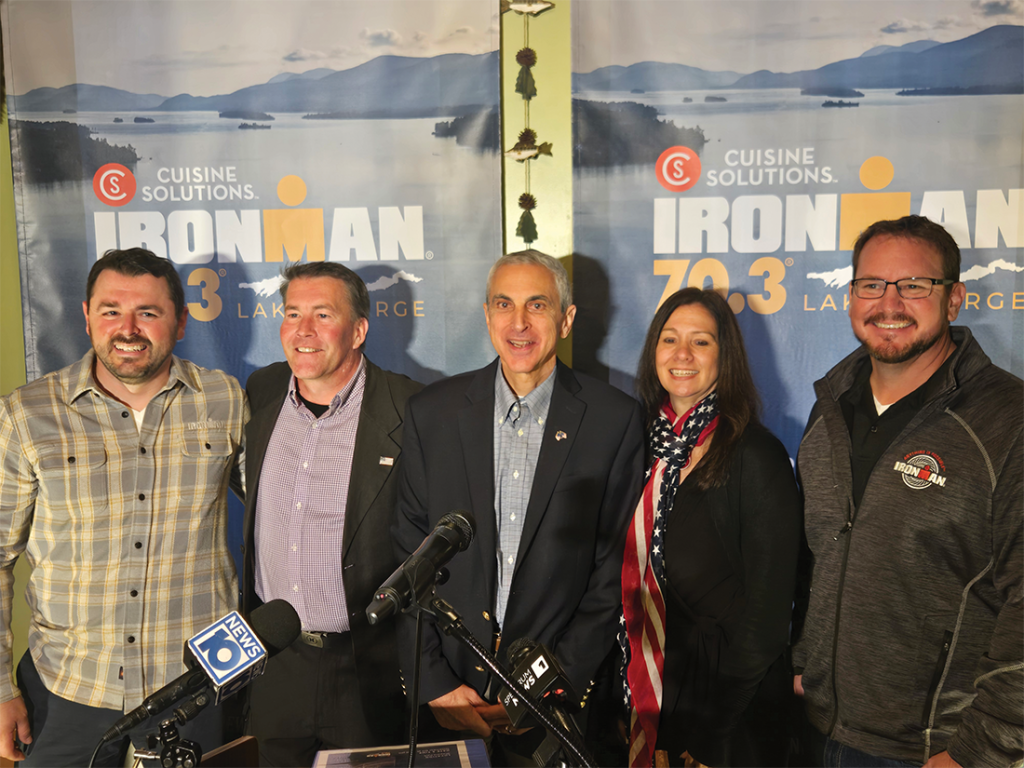
Courtesy Paul Post
By Paul Post
A first-ever Ironman 70.3-mile triathlon in Lake George and the return of the boys’ state high school basketball tourney to Glens Falls highlight the growing importance of sports tourism to Warren County’s economy.
This month alone, Harding Mazzotti Arena hosted the Adirondack Stampede rodeo, and the girls’ state volleyball championships (Nov. 20-22) and four more Thunder hockey home games are still to come.
Soon to follow, thousands of people will be hitting the slopes at Gore and West mountains, which employ hundreds of seasonal workers, pumping money into the North Country economy.
Ironman 70.3, scheduled for next Sunday, June 13, tests athletes’ endurance in swimming (1.2 miles), cycling (56 miles) and running (13.1 miles). A field of 2,500 contestants has signed up, and for every athlete, four or five friends and family members typically show up.
“They’re going to stay at our hotels, eat at our restaurants, shop in our shops, explore our towns and make memories here,” said Melanie Weber, Warren County Economic Development Corporation board chair. “Hopefully they’ll fall in love with this area, come back and decide this is the place they want to call home or start a business. That is economic impact that goes well beyond race weekend.”
“People relocate more now for place before they even think about job opportunities,” she said. “This place that thousands of people already visit every year is such an asset. We need to capitalize on that.”
Race day will be preceded by a two-day Ironman Village expo featuring dozens of local and national vendors offering merchandise and food in addition to musical entertainment.
Tampa-based Ironman Group is the world’s largest promoter and operator of mass-participation endurance sports, staging more than 200 events in 57 countries. A conversation between Lake George town Supervisor Vincent Crucitto and Ironman official John Poole over Thanksgiving dinner with mutual friends sparked the firm’s interest in Lake George.
“We knew immediately upon coming here, looking at the views, the region, the destination and the community that this was going to be something spectacular,” said Scott Straugh, Ironman senior director of global operations.
Next year’s race will be the first in a three-year agreement.
“After our second year we’ll likely look for a renewal and take it from there,” operations manager Matt Dimola said. “Hopefully the community loves us as much as we love the community.”
The boys’ state basketball tourney is coming back to Glens Falls in March 2028, also for three years. When local teams are involved, the three-day event sometimes attracts up to 30,000 fans, filling a void between the peak winter season and the start of summer tourism.
Glens Falls hosted the event for many years, but Binghamton won the current contract. Many future Division I college and several future NBA stars, including Jimmer Fredette of Glens Falls, have played in the tournament.
Tadd Sipowicz is Thunder team president and Harding Mazzotti Arena’s interim general manager. He said business and community support has grown exponentially for events held there, complementing Glens Falls’ ongoing revitalization.
“We have waiting lists for people who want to advertise on the (hockey) dasher boards,” he said. “It’s not just about downtown Glens Falls. The impact is from all around Warren, Washington and Saratoga counties where people are coming from. It’s huge for the bars, restaurants and hotels.”
Last month, about 900 athletes and coaches, 350 volunteers and numerous spectators came to Glens Falls for the three-day Special Olympics New York State Fall Games. “
“Multiple day sporting activities like the basketball tourney or recent Special Olympic games have an outsized impact on restaurants, retail businesses and lodging facilities both in and around Glens Falls,” said Jeff Flagg, city economic development director. “A study conducted after the last (basketball) tourney here, in 2024, estimated that the impact on the region was at least $2 million, including over $50,000 in sales and occupancy taxes.”
Many other events such as Adirondack Runners races, Little League and Adirondack Youth Hockey Association tournaments also contribute to the sports tourism economy. A record 400 adults and 70 children signed up for a Goblin Gallop 5K race on Oct. 31, and another large field is expected for the sixth annual Gobble Wobble on Thanksgiving morning in Glens Falls.
But one of the city’s most underutilized assets, with considerable economic development potential, is East Field. A recent master plan, developed for the city Recreation Commission, identifies wide-ranging priorities for all parts of the city-owned property, including the main baseball stadium, Little League complex, pool and quarry pond.
However, baseball stadium upgrades alone, such as a multisport turf field, improved lighting, new scoreboard, spectator seating, a concession area and parking would cost an estimated $12.4 million, and there’s no state or federal grant money on the horizon.
Meanwhile, there are serious safety concerns at the aging ballpark. Several times, foul balls came through the screen behind home plate during Glens Falls Dragons games last summer, narrowly missing fans seated there.
Sections of bleachers are closed for safety reasons, too, while trees and vines are growing up through other seating areas.
A statement attributed to Recreation Director Tom Girard, provided by the mayor’s chief of staff, Steve Thurston, said East Field is on the radar to be cleaned up and expanded in use. This fall alone the season was expanded by allowing three baseball teams of 13- and 14-year-olds to hold practice and weekend games at East Field, the statement says.
Through grant funding, plans call for building a splash pad at East Field next summer. “We have met with several interested stakeholders who have ideas about improving East Field, all while pursuing grant funding,” Mayor Diana Palmer said.