
By Ann Donnelly
Washington County leaders said rising state mandates and operating costs are straining the county’s ability to support business growth at Monday’s annual State of the County panel.
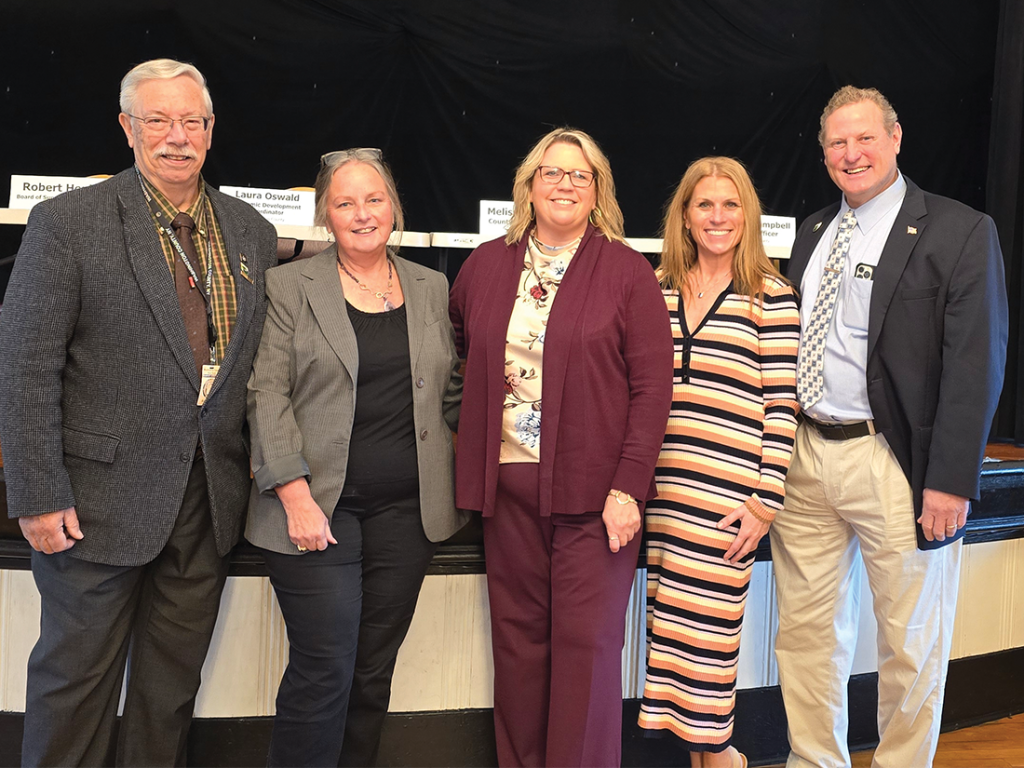
Adirondack Regional Chamber of Commerce President and CEO Tricia Rogers moderated the event at the Sandy Hill Arts Center in Hudson Falls, shortly after the county released its tentative 2027 budget. The $153.8 million net spending plan proposes a 9.79% property tax levy increase, bringing the levy to $48.67 million.
Officials said they cannot cut services that businesses and residents depend on, despite pressure on property taxpayers.
“80% of our budget is mandated costs, and we cannot do anything about it,” Board of Supervisors Chairman Robert Henke told the room. “I think it’s maybe closer to 90 now. The stuff we can actually affect and deal with is a fairly small part of the budget.”
Henke said regional wage disparities add to the county’s budget pressures.
“We have the distinction right now of being the lowest-paid, staff-wise, county in New York State,” Henke said. “Washington County is always on the bottom. It’s a tough pill to swallow when you’re looking at a big tax increase last year and something we don’t want to do again this year, but if we don’t, all our good people are gonna go.”
Budget Officer Brian R. Campbell said the county eliminated about 50 positions last year to reduce spending, but the cost of providing services has changed.
“Ten years ago our biggest challenge was overtime,” Campbell said. “Now overtime’s far cheaper than the pension costs and health care.”
The proposed 9.79% levy increase follows another steep increase in the previous budget cycle, Campbell said.
“I think with over a two-year period of a 27% tax increase, I don’t really think that we should make people paying the bill have less services,” Campbell said. “By having less people there doing the work, we’re finding efficiencies. We don’t fall behind with any of the services.”
County Administrator Melissa R. Fitch said county operations face the same fuel, utility and other cost pressures as businesses.
“We pay electric bills too. We pay a lot of food bills between our jail and Meals and Wheels,” Fitch said. “Our employees come at a cost because your services come at a cost. Our roads get plowed because we have people behind the wheel of that plow truck plowing those roads. These employees that live and work for Washington County are our neighbors; they’re in our communities. If they succeed, we succeed.”
Fitch said gaps in transit and child care limit employers’ ability to hire.
“The biggest gap would be transportation,” Fitch said, explaining that sparse rural populations make private fixed-route transit unprofitable.
Economic development coordinator Laura Oswald said infrastructure costs impede public utilities and commercial developers.
“Everything is stupid expensive right now,” Oswald said.
“What used to be $20 million or $30 million to put in a small wastewater plant is double that. And without that infrastructure, it is just about impossible for communities to make significant growth.”
Leaders said a $32 million New York state grant to the Washington County Sewer District will open key corridors to shovel-ready industrial and commercial development.
Oswald said the county’s aging housing stock complicates recruitment of skilled workers: About 65% of homes were built before 1970. She said, “For the past couple of years, the county initiated housing assistance programs in partnership with the state to enable people to live in their homes as they age, perform repairs, and improve quality of life for low-income residents.”
The county also created a land bank to rehabilitate tax-foreclosed and donated properties as an alternative to high-end construction.
Oswald said the Warren Washington Industrial Development Agency set aside $200,000 to study the creative economy as part of a regional collaboration.
“Creative businesses do not recognize borders, so we want to ignore that border and say, ‘How can we all work together?’” Oswald said, pointing out that small, nimble entrepreneurs are increasingly driving regional wealth creation.
Campbell warned that the 2027 budget relies on a record $31.5 million sales tax projection boosted partly by electricity and fuel prices that may fall.
Officials nonetheless argued that investing in staff and infrastructure is essential.
As Henke told the room: “You take what you can measure and you take what you can affect, and try to identify and grow it.”